


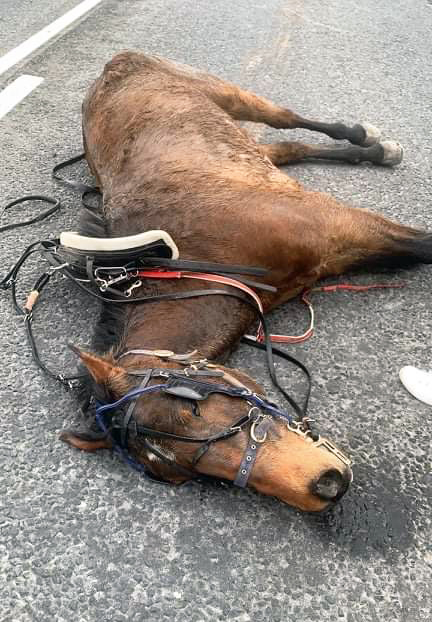
STRAY and malnourished horses remain an an ongoing issue in Limerick with communities across the city “abandoned” by the Council’s failure to tackle the problem.
So claimed Sinn Fein TD Maurice Quinlivan, as he raised the issue for the umpteenth time in the Dáil recently. Deputy Quinlivan also pointed out that former Independent Limerick TD, Mick Lipper, first raised the question of wandering horses in the same chamber as far back as December 1977.
In the past four years, an average of 92 horses were collected each year by Limerick City and County Council (LCCC). While this year, up to October 2025, the local authority collected only 52 horses, which Deputy Quinlivan put down to “a collapse in collecting horses”.
“Unfortunately, it remains a challenge that many Limerick communities continue to face,” he told the Oireachtas.

According to the Limerick politician, there still remains a prevalence of horses in green areas, and others are often stabled in derelict council houses or properties in city estates.
“In one day in February in the space of half an hour, I counted 50 horses grazing in urban areas. During my regular visits to many of Limerick’s urban areas, it is apparent that there has been no reduction in the number of horses. Unfortunately, it has got worse,” he insisted.
From an animal welfare perspective, Quinlivan stated that many of the stray horses that he has seen round Limerick City suburbs, appear to be malnourished.
“They are often tied to lampposts with hardly any space to roam. A dirty bucket of water is often next to them and they are neglected for days on end. In many cases they are ridden, violently whipped and made wander streets without appropriate horseshoes. It is shameful to see these beautiful animals treated in such a manner.”
From a community perspective, Deputy Quinlivan maintains that the mistreatment of these animals also has a real impact.
“I hear from local communities about the horses, and often foals, left injured and dead in their areas. Recently, I got a horse removed after it was lying dead at the back of someone’s home for more than a week. This is incredibly unfair to local people.
“We see many green areas destroyed, areas that should be used by children to play. Footpaths and open spaces are caked with manure and vacant houses are often commandeered without permission to stable these animals,” he said.
Deputy Quinlivan deemed the level of impunity “frustrating” for communities in Limerick City. The risk posed by these animals, particularly given the inexperience of some of their riders, he pointed out, is also a growing concern.
“Without decisive action, I fear injuries or even fatalities are inevitable. It is apparent that many left to care for these animals are children and teenagers. It is hard to believe, with such young owners, that any of these animals have been chipped and pinned as required by legislation.
“Over the years, via numerous parliamentary questions, I have sought to see how many prosecutions there have been regarding the failure to chip and pin a horse. ‘None’ is the answer I usually get. If a law is not enforced, it will not be abided by.”
Quinlivan went onto accuse Limerick City and County Council (LCCC), under the Government’s watch, of abandoning communities and failing to collect stray horses.
“The local authority will not collect horses in daylight, meaning there are very few horses around to collect at night-time, even though those horses can often be in the same green area for days on end. An Garda Síochána, which will need to assist, is often not available. The pound does not usually have the capacity to collect more than four or five horses at a time, and local Gardaí have told me it is not worth their while and effort to assist in collecting so few horses. Why is this legislation not being enforced?” he inquired.
Minster of State at the Department of Justice, Colm Brophy explained that the Department of Agriculture, Food and the Marine is responsible for all policy and legislation in relation to the Control of Horses Act 1996. However, Operation of the Act, he told Deputy Quinlivan, comes under the remit of the local authorities.
“Any reports of welfare issues received by the Department, including breaches of the animal welfare legislation, are acted upon and investigated. Appropriate enforcement action, where breaches or shortcomings are identified, is undertaken by the Department and authorised officers appointed under the Animal Health and Welfare Act 2013, including but not limited to An Garda Síochána, customs agents and local authorities. Primary responsibility for protecting the welfare of equines rest with the owner or the keeper,” Minister Brophy commented.
He also said that the Department provides financial support to help local authorities with the cost of seizures. The Department collects information from local authorities on a quarterly basis in respect of the overall number of equines seized by them.
“Currently, only the figures relating to quarter one and quarter two of this year are available, with the number of horses seized in Limerick over this period totalling 22. This number is down from the same period in 2024 where the number of horses seized was 45.”
Deputy Quinlivan took the view that while local councils have an important role to play the lead on this issue must come from the Department of Agriculture. He predicted that while the approach to enforcement by the Department remained “laissez faire”, councils will not treat this matter with the emphasis and urgency it requires.
“Good horse owners would have nothing to fear from legislation being enforced. I know many horse owners treat their ponies with care and compassion but the thuggish behaviour of a few impacts the reputation of all horse owners. It is time we stepped up and acted. There can be no tolerance for this abuse and anti-community behaviour cannot be tolerated.”
Minister Brophy replied saying the Department of Agriculture is committed to ensuring animal welfare standards are vigorously applied in a fair and even handed manner.
“The Department keeps animal welfare legislation under review with respect to developments in the areas of animal welfare and with regard to the practical lessons learned from the operation of the 2013 Animal Health and Welfare Act,” he concluded.
Funded by the Local Democracy Reporting Scheme.