


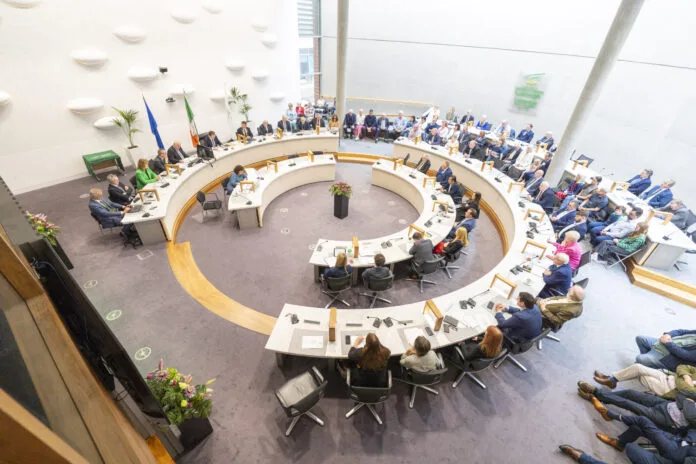
PUBLIC representatives locally have taken a very dim view of a call by the government to restrict media access to new community policing committees in Limerick.
The Local Community Safety Partnerships (LCSPs), currently being set up, aim to prioritise the voice of local people in identifying and addressing community safety issues, in collaboration with broad range of relevant stakeholders including local councillors, An Garda Síochána, community representatives, business and education representatives, and a range of statutory agencies including the HSE, Tusla, and local authorities.
Replacing the longstanding Joint Policing Committees (JPCs), the objective is to bring the relevant bodies together with communities in a collaborative manner, by focusing on the concerns identified and prioritised by local people.
Each newly established LCSP will be required to develop and implement its own tailored community safety plan and strategic approach to their work so that issues arising can be dealt with in a coordinated manner, addressed collectively by relevant service providers in partnership with the community.

However, the Department of Justice is now advising local authorities to restrict media access to the new policing committees for their first year of operation. LCSPs are only required to hold one of six annual meetings in a public forum.
Priomh Chomhairleoir of Limerick City and County Council, Cllr Catherine Slattery believes these meetings should be fully open to the media.
“What is being discussed is in relation to community issues and the community have a right to know what is being discussed and planned,” the Fianna Fáil councillor told the Limerick Post.
Social Democrats councillor Elisa O’Donovan equally deemed it very disappointing to see guidance from government that the media and public should be restricted from these new forums.
“Since I was elected six years ago I have advocated for live streaming of all Council meetings. We should be doing everything we can to make local politics and decision making as accessible to the people of Limerick as possible,” Cllr O’Donovan said.
“The whole aim of these committees is to ensure greater safety and better response to crime in our communities. The public and local media are key stakeholders in that. It is very concerning that there is a move to hold these meetings behind closed doors. All that will lead to is greater distrust in a system that already can be non-transparent and inaccessible to people,” she added.
Local Independent Ireland councillor Tommy Hartigan also expressed concern regarding the proposal. He pointed out that in the 18 months since his election to the Council in June 2024, a single JPC is yet to meet.
“While I fully acknowledge certain matters discussed by the committee may, at times, be of a sensitive nature, it is important to remember that appropriate mechanisms already exist to manage such situations — including the option of moving into a closed (in-committee) session when necessary. These provisions adequately balance the need for confidentiality with the principles of transparency and public accountability,” Cllr Hartigan stated.
“Local media play a vital role in ensuring that the public remains informed about issues of community safety and policing. Restricting their access risks diminishing public confidence in the committee’s work and could unintentionally undermine the spirit of openness that underpins our democratic process.”
Councillor Hartigan said he hopes that “we in Limerick maintain existing levels of media access, resorting to private sessions only when clearly justified by the sensitivity of the matters under discussion”.
A blanket ban doesn’t sit well
Sinn Féin councillor Sharon Benson said restricted press attendance will do nothing to instil public confidence in these new structures.
“There should of course be a facility to conduct some sensitive business in private. A recent Council survey noted that 80 per cent of respondents fear for their safety in the city centre. Holding meetings on public safety behind closed doors limits the information being provided to constituents regarding the actions being taken to target crime,” she explained.
Independent councillor Ursula Gavan raised concerns around transparency in local democracy if the Council is to hold meetings behind closed doors, even outside the scope of LCSPs.
“I don’t wholly agree with briefings and workshops behind closed doors. I have no issue if committee hold sections of their meetings in private where sensitive issues need to be discussed, but a blanket ban on press/public access to entire meetings doesn’t sit well with me,” Cllr Gavan said.
“We have a huge gulf between the ordinary citizen and decision makers in this country and this is another needless obstacle,” she added.
The National Union of Journalists (NUJ) has called on Justice Minister Jim O’Callaghan to urgently amend the guidelines Local Community Safety Partnerships allowing the new local committees to meet in secret.
The guidelines make media attendance discretionary and recommend that, in the first year of the new structure, three of the six scheduled meetings of the 36 partnerships should be held in private.
When launching the LCSPs earlier this year, Minister O’Callaghan said the new structures would operate “transparently and efficiently”, describing them as “a much more collaborative, responsive, and locally driven approach to community safety”.
Séamus Dooley, NUJ assistant general secretary, wrote to the Minister requesting an urgent amendment to the guidelines, describing them as being “in complete conflict with the principles outlined by the Minister and directly contrary to media policies being supported by the government”.
Mr Dooley said that “secrecy was for many years the hallmark of local government in Ireland. It beggars belief that an initiative hailed as ‘a fresh approach’ should seek to restrict media access to such a vital community forum, allegedly in the name of developing trust among the partnership members”.
“This is not a fresh approach but is instead a return to an old fashioned ‘Yes Minister’ view of public administration favoured by Jim Hacker rather than the open approach promised by Minister O’Callaghan.”
The NUJ assistant general secretary noted that “Joint Policing Committees were open to the media. The new committees involve public bodies such as the Health Service Executive, the child and family agency Tusla, and local authorities, and have a much broader remit. For this reason, the NUJ believes the discretion allowed to committees to exclude the media is of particular concern.”
“There should be a presumption that meetings will be held in public. If there needs to be a private session to discuss matters of particular sensitivity, standing orders could allow this, as happens at local authority and Oireachtas committees.”
‘A major mistake’
Local Sinn Féin TD Maurice Quinlivan told the Limerick Post that he believes it extremely important that we get the new LCSPs right, particularly here in Limerick.
“The previous version of these, the Joint Policing Committees, whilst far from perfect, played a very useful role in helping to tackle crime and anti-social behaviour in Limerick. Across Limerick, we have an ongoing feud amongst rival drug gangs, a drug epidemic – especially with crack cocaine – an ongoing challenge with the misuse of e-scooter vehicles, and the persistent issue of stray, malnourished wandering horses. Media need to be present at these meetings so that the public can hear what, if any, action is being taken by their political representatives,” Deputy Quinlivan declared.
He also hit out at the fact that not all TDs and senators will have the opportunity to attend these meetings, describing it as “a major mistake”.
“A blanket ban with the press attendance at ‘the discretion of the chair’ is not the correct approach to take. The lack of public scrutiny on policing matters, that impacts the lives of the public, serves only to make people suspicious of the nature of the business being conducted behind closed doors.”
Deputy Quinlivan also takes the view that policing works best in partnership with the public.
“I also have concerns at the restrictive nature of the meetings, with only seven councillors attending and still no clear understanding as to how they will be selected,” he said.
Limerick Labour Party TD Conor Sheehan also believes that media coverage is an important way to ensure the public are kept informed and politicians are held to account.
“There is no rationale for restricting media access to the Local Community Safety Partnership. The media were always present at the former Joint Policing Committees and their presence never created any issues,” he said.
“This was an important part of keeping people informed and ensuring policing and political accountability. People need access to accurate public information about policing. This decision will mean less coverage and less scrutiny on policing and community safety.
“People need to have confidence in policing. Allowing transparent news reporting will only serve to improve confidence in policing. The lack of democratic input into these new Local Community Safety Partnerships is worrying, there are only seven Councillors, no TDs, and no media scrutiny.”
‘Transparently and efficiently’
Minister for Justice Jim O’Callaghan said at the launch of the regulations for the LCSPs in June that they outline how they will operate in practice, “transparently and efficiently”, with each LCSP having a clear mandate and strong local engagement at its core.
“Community safety means local elected representatives, State agencies, community organisations, and the public working together with An Garda Síochána to help make our communities safer and more connected.
“While Ireland is generally regarded as a safe country with relatively low crime rates, some communities may experience a different reality. We need the structures in place at a local level so longer-term solutions that are not focused solely on policing can be put in place. Public lighting, waste collection, public spaces, the location of services, can all contribute to feelings of safety in our towns,” he said.
When contacted for comment, a spokesperson for the Department of Justice said that the National Office for Community Safety has issued a comprehensive guidance document for the establishment and operation of LCSPs to chief executives of local authorities and their staff to support the establishment of the structures in their administrative area.
“This guidance document aims to provide clarity and direction to Safety Partnerships but also allows flexibility to develop and implement arrangements that are responsive to local circumstances and community safety needs. It is a ‘living document’, which can be updated to reflect new learnings, as well as changes in policy and operational context. It has been informed by the learnings from the independent evaluation of the pilot Local Community Safety Partnerships, which includes the Dublin North Inner City, Longford, and Waterford pilots.”
The Justice Department spokesperson told the Limerick Post that “transparency and accountability to the general public and media are an important factor of the Safety Partnerships’ work. The guidance provides that they will be able to facilitate media attendance at meetings at their discretion and by way of a request to the Chair.”
“It should be noted that, whilst Local Community Safety Partnerships are hosted by local authorities, they are not a committee of the council. In accordance with the recommendations of the Commission on the Future of Policing, and in recognition that community safety is not solely the responsibility of An Garda Síochána, they bring together a broader range of relevant stakeholders to identify and respond to issues relating to community safety in a coordinated, proactive way.
“The work of Local Community Safety Partnerships therefore is relational and based on a partnership approach. The guidance suggests that Safety Partnerships give consideration to holding meetings in private to allow for relations and trust to develop among members and as the Safety Partnership develops its workplan. As noted in the guidance, this approach should be reviewed as the Partnership’s work evolves.
“In recognition of the need for transparency and the important role of the media the guidance also advises that where a Local Community Safety Partnership holds meetings in private, an agreed report of the meeting should be made publicly available and that such reports be shared directly with the media as part of a Partnership’s communications strategy.
“Additionally, as outlined in the Regulations for the operation of Local Community Safety Partnerships, they may hold as many meetings as required but must meet at least six times a year, including one public meeting, which all members of the community, including the media, can attend.”
Funded by the Local Democracy Reporting Scheme.