


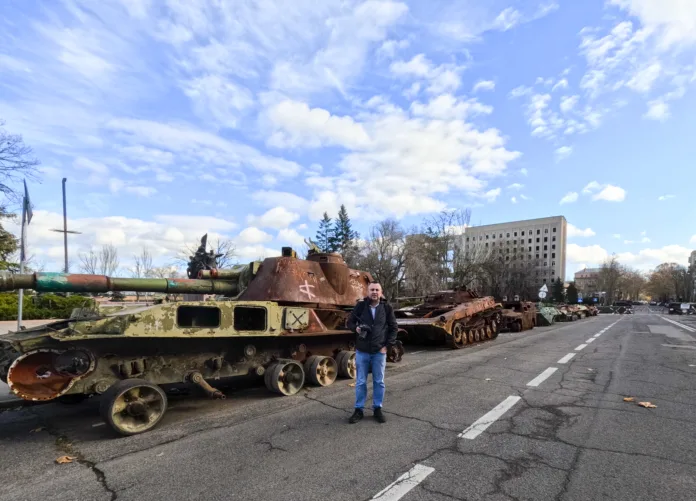
NEARLY 3,000 Ukrainians continue to call Limerick home this Christmas, almost four years on since Russia invaded the country, which at the time marked a major escalation of the war since it first began in 2014.
Talks held last week between US, European, and Ukrainian officials aimed to end Russia’s war in Ukraine, described by a US special envoy as “productive” and “focused on aligning positions”.
However the bloodshed most people only witness on their television screens is something Limerick photographer David Hayes gotten up close and personal with, returning from his third tour of war-torn Ukraine at the beginning of the month.
“Even Ukrainian cities that are not under Russian occupation still live with the daily threat of rocket attacks on their communities and energy infrastructure. My experience in Ukraine has been daily and nightly air raid alarms, restaurants forced to stop business and regular power cuts that leave you in total darkness,” David told the Limerick Post.

The Kileely man first travelled to Ukraine in 2019 after reaching out to journalists in Kharkiv, the countries second largest city 20km from the Russian border, photographing displaced personnel from Ukrainian cities Luhansk and Donetsk.
He later travelled to Slovansk in Eastern Ukraine documenting scenes of war from the 2014 invasion.
“In 2019, I only came across one military checkpoint, but during my most recent visit this year, there was military checkpoint after military checkpoint,” he said, describing “the plumes of mushroom cloud smoke” as he travelled the city.
On his most recent visit through the south of the country, David was detained on the side of the road, his phone and passport confiscated.
“Not being a Ukrainian citizen, I was not allowed to continue my journey to Kherson, not even credited journalists are permitted to enter.”
Three days later, Russian forces killed a 34-year-old woman from Kherson and her six-year-old child in the Korabelnyi district. A 50-year-old man was also hospitalised with injuries.
He also met a man whose mother-in-law fled to Limerick and has met several Ukrainians in Ireland who have shared their personal stories and wondered when the war in their home country might finally come to an end.
For those who remain in Ukraine, David says that despite the bloodshed, life goes on and Christmas celebrations will continue with some celebrating on January 7 according to the Orthodox Church of Ukraine.
“They have to live their life too, they’re not sitting at home depressed, they are out working, make their money, go out for a coffee, but the constant threat of Russian invasion is always there.
“It has to take its toll,” he says.
David has since safely returned home to Limerick but is keen to show his solidarity and to counteract what he describes as the “narrative that there are safe places in Ukraine”.
“No part of Ukraine is safe at the moment. Civilians are still living with Russian drone strikes, if you could imagine living in Castletroy for example and all you see are nets above the streets to stop the drones coming in,” he shared.
“Then there’s the psychological impact for people, young people in particular, who are living in a country that can’t grow and prosper economically.
“Life is far from being back to normal in Ukraine.”