


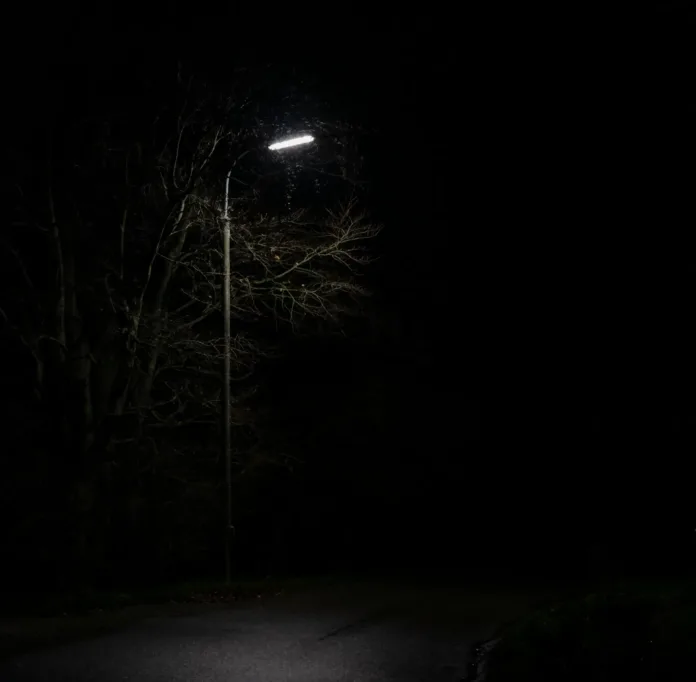
LIMERICK Council heard how a 92-year-old woman living alone in Kileely is frightened to leave her home and go to Mass on a Saturday evening because of poor quality street lighting in her area.
The local authority also heard at a special meeting on the Public Lighting Energy Efficiency Project (PLEEP) how a wheelchair bound resident in her 60s is also fearful of going out after dark for the same reasons.
The goal of the national project is to convert public lighting to LED technology in all the local authority areas taking part. This, Limerick councillors were told, will make public lighting significantly more energy efficient and generate substantial energy savings.
However, Sinn Féin councillor Sharon Benson, who called the special meeting, raised serious concerns following numerous calls from city residents on the quality of the new street lighting.
Parts of the city where PLEEP has been rolled out, she claims, have been left in near darkness, with members of the public feeling at risk.
“It’s very difficult to hear old people who are refusing to go outside the door or to Mass, to do something that they attend every week, because of these lights. So to me, this does not sound like a liveable Limerick. To me, it does not sound like an age-friendly Limerick, and it certainly does not sound like social inclusion,” Cllr Benson told the Council executive.
“These lights can and are creating social exclusion. Another resident had to paint the steps to their home white so they wouldn’t fall. I’ve had concerns about this PLEEP program for a very, very long time, particularly around value for money, and it appears now that the chickens are coming home to roost.”
Cllr Benson said that “in 2020, I queried the cost of installing 5,200 streetlights across the city. At the time the Council agreed to borrow €12million to replace all streetlights with LED lamps. The response I received did not answer the question on costs, it appeared at the time that the Council did not know the costs.”
“I stated in 2020 that this massive loan was going to impact the Council for the next 15 years. It seems at this juncture the PLEEP scheme is not delivering for Limerick residents despite the financial cost. These lights need to be replaced and ‘the computer says no’ response is not going to cut it.”
An issue of ‘perception’
Cllr Benson proposed a pause in the installation of lights until Cork City Council, the lead in the PLEEP project, comes before Limerick Council to answer questions, and until a review has taken place and legal advice sought.
“Some of the communities we received calls from were areas such as Ballyanty, Sarsfield Avenue, Garyowen, Pennywell, Norwood Park, Kilteragh, and Carew Park, and that’s just to name a few. You do not have to be an engineer to know that these lights are wholly unsuitable and not providing sufficient light levels to be safe,” she said.
“I am concerned that this lack of lighting in residential areas is a risk to residents, particularly among our more senior citizens. At a time when safety is cited as a major concern for people, we need more light, not less,” the City North representative insisted.
The Council stated that, since the end of last year, it has already seen a reduction of energy use by six per cent since implementing the PLEEP scheme. While energy performance, councillors were informed, is up seven per cent in the last 12 months. The Council also suggested that the lights, which are the same standard design across the country, could simply be an issue of “perception”.
Cllr Benson was not impressed.
“I ask that you go over to Kileely and actually stand there at night. It’s not perception. I’ve had people come to me and say, ‘I thought you were being dramatic’, but they went out there and by God you can see it’s no joke,” she insisted.
Labour councillor Pádraigh Reale seconded Cllr Benson’s motion and told Council management that the people of Limerick are very concerned about the poor lighting in areas of the city.
“I’m all for the move towards more sustainable lighting but not at the detriment of public safety. If our general public don’t feel safe, we’re not doing right by them. If we keep moving in this direction, we’re going to have more public liability cases coming before the local authority,” Cllr Reale said.
“Some of our elderly residents don’t feel safe at night and at this time of year we are already living with very few daylight hours, so we are restricting the most vulnerable. The concerns out there are real.”
‘I didn’t see the man until he was on top of me’
Independent councillor Maria Donoghue said that, as the winter months have encroached, the number of calls around lighting have increased.
“I had one call in October when a girl was physically assaulted leaving work. She was assaulted on Henry Street at half seven in the evening, and she didn’t see her attacker was agitated until he was on top of her,” Cllr Donoghue explained.
“She could see a person approaching, but she couldn’t see that he was a threat to her safety. I had another lady tell me that she was walking down Alphonsus Street towards the shop there and she was very aggressively begged from, and she said, ‘I didn’t see the man until he was on top of me’. I’ve had situations in town where people have walked out in front of cars and the drivers didn’t see them until it was nearly too late. This issue is across residential areas in the city centre.”
Fine Gael councillor Stephen Keary pointed out that the issue of poor lighting was not just a problem in the city, but in the county also. He took the view that the local authority is leaving it at the behest of contractors to go and check lighting to ensure it is working.
“I know an estate in Adare where there are no lights working,” Cllr Keary claimed.
Newcastle West area representative Cllr Jerome Scanlan (IND) also cited cases of poor lighting in his district, saying: “To put it at its mildest, we were without lights in a certain vulnerable section of the town from last February until two weeks ago. This is totally unacceptable.”
The Council said it will call on Cork County Council to attend a meeting in the new year to answer questions from local representatives regarding poor lighting.
Funded by the Local Democracy Reporting Scheme.