


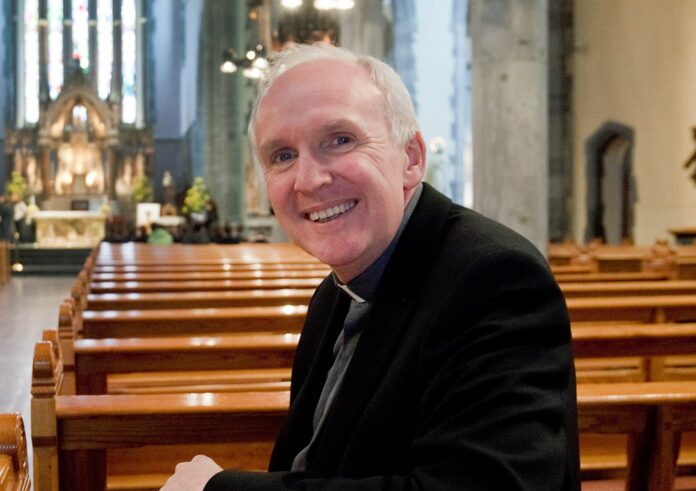
IN a week that saw the United States carryout a bombing campaign in the Venezuelan capital, the Bishop of Limerick, Brendan Leahy, has called for a national plan for “peace-building”, so that the Irish may become “exemplars of peace here and internationally”.
In his World Day of Prayer for Peace 2026 message, Bishop Leahy said that “while we all want peace, and it is very fragile today, we must all commit to it personally and, in doing so, send a collective message that it is a priority for us”.
He said that Irish people are “rightly” proud of their tradition of neutrality, “but we can’t be naïve and simply adhere to a passive notion of neutrality”.
“Our collective identity, if it wants to be one characterised by peaceful neutrality, needs commitment and a clear statement owned collectively by us all that the active promotion of peace is a priority for us,” Bishop Leahy said.

Adding that while people should be “grateful” for the “diplomatic pathways already formulated by our government” and “the many wonderful gestures of generosity and kindness on the part of many in our society”, “it would be good if an overall high-level national integral strategic plan of peace-building were formulated”.
Bishop Leahy said that “neutrality is a high ideal, but the ideal is not enough”.
“We can be rightly proud of the peace-keeping activities performed by our Defence Forces, but they alone are not enough. Peace is more than simply the absence of war. We need to be a country where peace, in its fullest sense, is articulated and stated clearly as a political and social priority with a commitment to becoming a country known as a pro-active artisan of peace.”
“With 61 wars going on across the world, we are now in a dangerous period, with many concluding that we are heading for war in Europe – a concern that is shocking given the hard-won lessons of the twentieth century.”
Bishop Leahy also said that “the sense of a violent world” permeates also at home here in Ireland.
“Even locally, in our own country and around us, we have to admit there are many threats to personal and social peace,” he said.
“We hear of violent crimes, domestic violence, drug criminality, human trafficking, and expressions of racist intolerance of people seeking refuge here having had to leave their homeland because of war and persecution. And there is the legacy of wounds of terrorist activity and all forms of abuse.
“As human beings who long for peace and as Christians mandated to cultivate peace in our world, what are we to do, faced with the increased talk of warfare, the increasing tendency in Europe to arm ourselves more, and then the growing temptation, as Pope Leo puts it, to weaponise even thoughts and words in social media outlets and in other ways?”
The first step, Bishop Leahy says, “is always personal and that that people of religious convictions must draw on the deepest resources of their religion to build themselves up as people of peace”.
“But peace is never just an individual achievement. It is together that we are to promote unarmed and disarming peace.”