


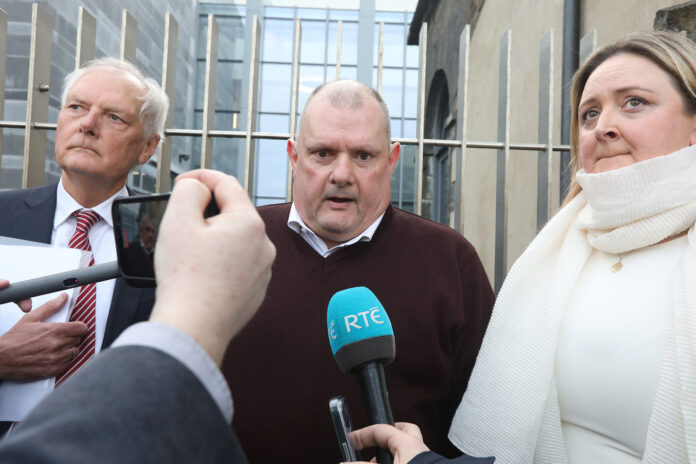
THERE were joyous scenes at Limerick Circuit Criminal Court this Monday as retired superintendent Eamon O’Neill and four serving Gardaí were found not guilty on all charges of attempting to pervert the course of justice.
The nine-week trial heard that Mr O’Neill led the fight against gangland criminals in the Treaty City and put his life on the line to restore peace on the streets.
Mr O’Neill and his co-accused, Sergeant Anne-Marie Hassett, Sergeant Michelle Leahy, Garda Tom McGlinchey, and Garda Colm Geary wept and hugged one another in court after the jury returned unanimous not guilty verdicts.
29 not guilty verdicts for each charge were read out by the court registrar, followed by cheers and applause from families of the five accused, as well as a large gathering of serving and retired Gardaí.

A second court was opened for the public due to the swell of attendees who came to see the finale of what was the longest criminal trial before Limerick Circuit Criminal Court.
The State alleged Eamon O’Neill gave preferential treatment to motorists he knew or had a close contact with by attempting to quash their potential or pending road traffic offences. The State accused the four serving Gardaí of being cohorts.
The jury disagreed and acquitted Mr O’Neill of all 27 charges against him and the four serving Gardaí of the remaining 12 counts.
Speaking afterwards, Mr O’Neill fought back tears and said he and his four accused had been left “devastated” by the investigation and trial.
Mr O’Neill’s barrister, Felix McEnroy, argued in court that the Garda National Bureau of Criminal Investigation (GNBCI) investigation into Mr O’Neill was based out of a “vicious” pursuit after a prior GNBCI probe into O’Neill for other alleged offences failed to land a punch.
What the jury did not know was that Mr O’Neill endured 100 days in psychiatric services due to the strain of the GNBCI probes.
That strain showed in the emotion of the five accused outside the court once proceedings finalised.
“I have mixed emotions, I have never felt pressure like it in my whole life, but there’s relief now, I need time with my family to start a new chapter in our lives,” Mr O’Neill said.
Mr O’Neill said he had felt like a “dead man walking” with the charges hanging over him, and was treated as “an outcast and a leper” by some within the force.
Mr O’Neill said he had given “everything” to An Garda Síochána, “but if they decide that you fall, you fall very heavy and they come after you”. He said his message to the those who sanctioned the GNBCI investigation into him and his colleagues was a simple one — “Shame on them”.
Mr O’Neill’s solicitor Dan O’Gorman said the lives of the five accused had been “ruined” by the failed GNBCI probe and State’s prosecution and that the Garda Commissioner needed to take note.
“The State with all its power came after Eamon O’Neill and the other accused. The State said ‘yes’ and the jury said ‘no’. The people have spoken and the State must and will listen.”
Mr O’Gorman called for a public enquiry into the circumstances of the GNBCI probe that led to the arrest and charge of the five accused.
The court heard the GNBCI carried out a dawn raid on Supt O’Neill’s house, hauled him out of bed and held a photograph of his infant son in front of him when interviewing him. They also produced a photo of Garda McGlinchey’s daughter in front of him when questioning him.
Gardaí attached to the GNBCI involved in the prosecution left the court without making any comment following the verdict.
O’Neill’s barrister, Felix McEnroy, said the GNBCI probe and subsequent prosecution had “a vicious undertone” throughout. He suggested the case was brought against Mr O’Neill because the GNBCI had previously committed money and resources on a prior investigation into Mr O’Neill, for which he was found to have had no case to answer.
The arrest of Mr O’Neill was his “crucifixion” and the charges against him an attempt to “cremate” him, defence barristers said, adding the four other accused were “the kindling” around Mr O’Neill’s feet.
Chief Superintendent Walter O’Sullivan, now retired, who was head of the GNBCI at the time, denied these claims in court.
The Garda Press Office said it does “not comment on decisions of the court” nor on comments made by third parties.
– Court Reporting Scheme