


LIMERICK City and County Council has been urged to introduce a total ban on the use of glyphosate and other toxic chemical pesticides by its staff and contractors, except in exceptional circumstances, such as control of alien invasive species.
Glyphosate is the active ingredient in weed killer Roundup, and concerns about the chemical were recently raised by councillors around its use in communities across the county.
Social Democrats councillor Shane Hickey-O’Mara proposed the local authority makes a firm commitment to ensure that if/when it uses glyphosate or other toxic herbicides and pesticides in a community that it inform the community in advance via a letter drop indicating the precise location it will be used in.
He also wants the Council to erect warning signs or notices at the precise location before and after spreading, as well as using any viable alternative to glyphosate or other toxic herbicides in its work. Additionally, he wants the local authority to agree to end the use of glyphosate and other toxic herbicides in Limerick communities by a fixed date.

“I wish to thank the Farranshone residents who initially raised their deep concern about Limerick Council spraying glyphosate, a poisonous herbicide, in their community last September. This was carried out without any warning and without the erection of signage informing individuals and families that this chemical was being sprayed. Such disrespect for residents cannot be allowed to continue. Phasing out the use of such dangerous herbicides in Limerick is crucial – such an action is pro-public health, pro-biodiversity, and pro-wildlife,” Cllr Hickey O’Mara insisted.
The crux of the matter, the City North representative explained, is that residents don’t want poisonous chemicals sprayed in their communities.
He said he had put forward a motion calling for the Council to “develop a policy document in relation to the use of glyphosate and other herbicides in Limerick. It’s time for staff to stop burying their heads in the sand and actually start listening.”
Cllr Elisa O’Donovan supported her Social Democrats colleague’s call and took the view that there are lots of natural, organic alternatives to glyphosate.
“I think it is critical that we are looking for an alternative,” Cllr O’Donovan told the Council executive.
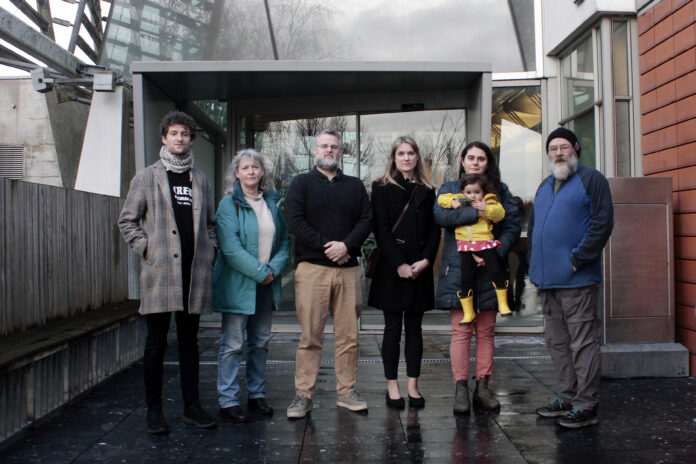
Beyond Glyphosate Limerick, a group of Limerick natives and residents, teachers, scientists, parents, and environmentalists concerned about the use of pesticides (mainly glyphosate- based weed killers) in public spaces in Limerick City and County, supported Cllr Hickey-O’Mara’s call, turning out on the day at County Hall.
They raised serious concerns over glyphosate-based herbicides currently being the “go-to” for the contractors employed by the Council.
“It is sprayed liberally on footpaths, on green spaces, around trees and bushes, children’s playgrounds in Lough Gur and Croom, and close to private homes. There is never any warning from the Council about application times, and there is never any signage after the spraying is completed. It can take up to seven days for the weeds to change colour, so it is impossible to know when and where it’s been applied. And it doesn’t wash off in the rain, unless you have a power washer – once its dry, it’s made to stick,” Beyond Glyphosate Limerick claim.
‘Dangerous and out-dated’
The group’s mission, they say, is to end the use of all pesticides in public spaces. They deem this practice dangerous and out-dated.
The group says there are plenty of alternatives such as Foamstream, mechanical weeding machines, mulch, salt, or organic vinegar-based weed killer.
“Counties Cork, Wicklow, Dublin, and Westmeath all have robust no-pesticide use policies, and they are managing just fine,” they said.
In October 2023, Green Party councillor Seán Hartigan called on the Council to introduce a total ban on the use of glyphosate and other toxic chemical pesticides by staff and contractors, except in exceptional circumstances, such as control of alien invasive species. Now, he has again made this call.
“According to the World Health Organisation glyphosate is ‘probably carcinogenic to humans’. It has been the subject of two recent high profile court cases in the US. In 2020, its manufacturer Bayer agreed to settle a wave of lawsuits over the potential carcinogenic effects of the herbicide,” Cllr Hartigan told the Limerick Post.
“The courts found that years of use of the popular weed killer had caused non-Hodgkin lymphoma with settlements agreed for more than 100,000 people. The European Commission is re-evaluating glyphosate, primarily because of human health concerns, with results due later this year. It has been or will soon be banned in at least 10 countries, and at least 15 others have restricted its use. Farmers in Germany must stop using it completely from 2024.
“It is highly unlikely that glyphosate will be available to the amenity sector to the extent it has been for much longer. Irrespective of how the EU licence renewal develops, the fact remains that the public have a reduced tolerance for its use,” he said.
A recent study conducted by scientists at Trinity College Dublin and Dublin City University reported the chemical’s presence in unsprayed wildflowers growing near sprayed fields, finding that it damages the digestive systems of honeybees and bumblebees, making them more vulnerable to infections with other negative consequences. Recent studies at University of Galway have detected traces of the glyphosate in a quarter of people tested.
Tried and tested alternatives elsewhere
In reply to Cllr Hartigan’s question on glyphosate usage in 2023, the Council said that weed spraying is not carried out in its various parks throughout the city and county.
“Reports I’m getting from the public contradict this. I was also told the cleansing section manage a weed spraying contract which covers public roads and adjacent footpaths in Limerick City and has increased glyphosate usage year-on-year to the point where we are using 600 litres per year of undiluted (360g/l super concentrated weedkiller) spray per year,” Cllr Hartigan claimed. “This translates into 30,000 litres of atomised spray released into public places in Limerick per year.”
“Under EU regulations, pesticides should not be used in areas used by the general public without documented evidence to state why an alternative would not work. There are alternatives, but we are just not using them,” the City East representative opined.
Since 2020, Louth County Council are using only “organic non-pesticide products”, Cork City Council, Dublin City Council, and Dún Laoghaire–Rathdown County Council are only using chemical herbicides to treat invasive species. Many other Councils are leading a research project looking at assessing alternatives to herbicides.
“I am asking Limerick City and County Council to follow the lead of Louth, Cork, Dublin City, and Dún Laogharie-Rathdown to ban all use of glyphosate except in exceptional circumstances such as the control of alien invasive species to protect both biodiversity and human health,” Cllr Hartigan declared.
Limerick Council said it would look at all the elements raised by councillors around the use of glyphosate and come back to them on it.
The Council’s Director of Travel and Transportation, Patricia Liddy, also pointed out that the European Commission approved the use of glyphosate until 2033.
“It’s not illegal. But we absolutely do understand that there should be one policy within the organisation, if it works effectively and we can prove that, we’ll bring that back here,” Ms Liddy concluded.
– Local Democracy Reporting Scheme