


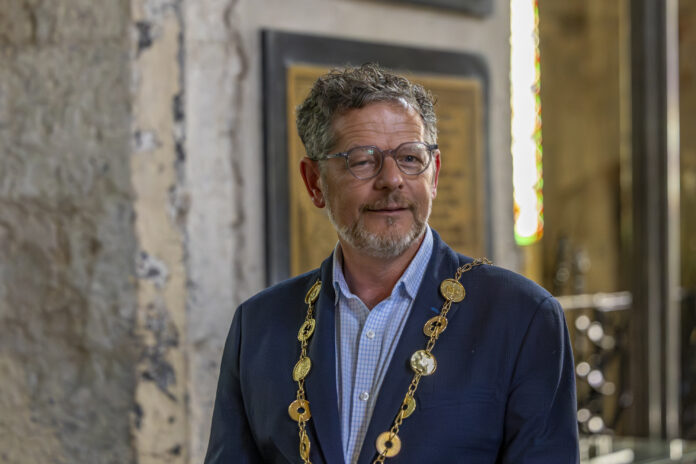
ONE Limerick councillor warned recently that the local authority is “seen to be a malfunctioning force, and the sooner we cop ourselves on and do our business right, the better”.
Tensions, however, between Limerick City and County Council’s two top men, Mayor John Moran and Director General Dr Pat Daly, have only continued to escalate following a controversial interview last October on Live 95 in which our first citizen was deemed to be critical of staff and Council management on delivering for Limerick.
Speaking to Joe Nash on air last autumn, Mayor Moran said he had sent back proposals during his time in office he did not feel were “good enough”.
The Council’s Director General responded to the Mayor’s comments with an internal email assuring staff and elected members that he shared the disappointment some held in Mayor Moran’s remarks.

“While it is natural to feel disheartened, it’s important that we focus our energy on what we do best, that is, serving our community with professionalism, integrity, and pride,” he wrote at the time.
He told Council staff that “many of you have taken on additional responsibilities, often at short notice, and have done so with great professionalism and a can-do attitude. Please know that your efforts are seen and deeply appreciated”, telling them that the Council remains “committed to maintaining a positive, respectful, and productive working environment”.
A week later the rift between Mayor, Council executive, and local representatives widened further when councillors passed a vote of confidence in Dr Pat Daly and his team, while Moran received a major backlash for what was deemed his “toxic” radio interview.
“A pattern has developed for quite some time that when you come under pressure to deliver for Limerick, you blame others. It’s now time that you step up and accept your responsibilities,” Fianna Fail councillor Michael Collins told Mayor Moran.
Cllr Collins claimed that Council “morale has never been as low” since the 2024 mayoral election.
“We’ve seen management personnel leave. We’ve seen senior staff members leave … I’m also aware of staff members out on sick leave,” he added.
‘Who’s the gaffer?’
So far in 2026, there has been little or no sign of harmony in City Hall. The Irish Times even pointed to documents released under Freedom of Information showing trade union Fórsa expressing “serious concerns” regarding the working relationship at the head of the local authority.
This week saw further turbulence during Monday’s full Council meeting. Fine Gael councillor John Sheahan suggested the Council was “a laughing stock” in Dublin, before asking the top table: “Who’s the gaffer?”
“Ye need to get in a room and grab this thing by the horns. We need a roadmap for who is responsible for what,” he told the Mayor and Director General.
In response, Dr Daly confessed to Council members that there still is “settling in pain”, and agreed it is difficult with all eyes on the local authority and the press reporting on a “perceived split”, suggesting some “ground rules” need to be laid down.
Ahead of this week’s fiery assembly, the Limerick Post sat down with Mayor Moran to discuss the current impasse and how the deadlock might be broken. I begin by asking the directly-elected Mayor if the ructions we have seen within the Council in recent months suggest he is doomed to failure?
Looking somewhat sequestered, he was keen to express the trials of this new marriage without ruffling further feathers.
“It’s like this, all of the powers of the previous Chief Executive are given to the Mayor, and certain listed powers are given back to the Director General, and anything that isn’t listed is with the Mayor, which is a really important difference, because it sort of means that the Mayor picks up the generic stuff,” Mayor Moran quickly explains of his understanding of the role.
Does the Director General see it that way, I ask?
“He agrees with me up to that point. Then there is Section 149 (in the legislation creating the mayoral role), which used to say that the Chief Executive runs the organisation. He’s responsible for the operation of it, answering questions from councillors, that kind of stuff,” he explains.
“In the case of every other CEO”, the Mayor said, that interpretation includes employees of the organisation.
“Then when they came to the Limerick Mayor, they said, Pat you keep that for your functions, and Mayor, you get the same responsibility for yours, but we take out that piece about employees. This means he gets HR.”
As a result, the Mayor claimed, “I can’t do anything in HR”.
‘Because of who I am’
“There’s another section (in the legislation), 159, that says, as amended, that the Director General will do everything necessary for the fulfilment of his own functions and the function of the Mayor, in terms of staffing and organisational resources. What that’s supposed to equate to, in my mind, is that when you’re a Minister you have a Secretary General who makes sure the department works to do your bidding,” the Mayor continued.
I ask the Mayor, as a person who long campaigned for the institution of the mayoral role for Limerick, if he had predicted that this was how things would play out.
“I think this has developed because of who I am, in terms of me coming in here knowing I had five years to really make a difference,” Mayor Moran shared.
“I’m skilled enough to see what’s wrong, which maybe some of the other candidates would have been less experienced at. I don’t think the other candidates would have read the Local Government Act as carefully as I did, so they would still happily be doing stuff, and I think that has meant the identification of the role of Mayor has now become what it should be right now.”
The Mayor suggested that “the problem Limerick had in the past, indeed as all local authorities have, is the councillors are all part-time, and they don’t get time to interrogate the functioning of the organisation. When you’re full-time and you work two days every day, you get to see an awful lot of information, and you get to see things that are working well and things that are not working.”
When I asked the Mayor for an example, he drew my attention to a press release issued the same day as our interview, announcing his intent to conduct an independent evaluation into why housing in Limerick has been so far below needs. He took the view that while Limerick delivers at most 800 to 1,000 new homes a year, we need at least 2,599 annually just to meet existing targets.
“In truth, to address pent‑up demand, we need closer to 4,000 homes each year. I’m trying to get things changed. I’m trying to get a Housing Activation Unit. In some ways, if you were fearful of that, it could be perceived by the outside world as an admission that it wasn’t working before. It’s a tough thing to do,” he said.
‘It’s not the organisation against the Mayor’
The other issue, according to the Mayor, is how the organisation was previously and, he claims, still is to some extent, managed in a very “siloed” manner.
“If you’re doing a lot of operational stuff, if you are fixing a street, it’s fine to give that to whoever happens to have public realm over roads. But if you’re not really thinking strategically, it doesn’t matter if you give some of the roads to public realm. Now landed on top of that you have a rather strategic thinking Mayor who has a programme that is cutting across different silos within the organisation, and going on beyond into Irish Rail and the HSE and everything else, so it doesn’t fit with the structure,” he shares.
Despite the difficulties, Mayor Moran remains upbeat, optimistic, and positive about the rest of his five-year term. When I ask if his role is now untenable, he laughs.
“This is an important point. The reality is that most of the people in here are doing a super job to do what I’m asking them to do, and there’s only very rare occasions where there’s a difference of opinion between how I would like something to happen and how the Director General would like it to happen,” he says.
“It’s not the organisation against the Mayor. It’s more of a need to define what the change was actually in the only place that matters, which is the role of the chief executive.
“I often describe this job as being like flying a plane. If the plane goes down it’s always the pilot you start to blame because they are supposed to be in charge of the direction and how to deal with a crisis.
“Then there’s a co-pilot, who, if necessary, can take over if the pilot gets a heart attack. But the co-pilot will inevitably have been given responsibilities before they take off from the first airport to do themselves.
“They may have responsibility for making sure the meals are served, the everything works in the staff, and picking who is coming on the flight. The pilot’s not got that responsibility and, at the moment, I don’t think it’s working because I don’t think the legislation gets clarity.
“In the situation where the people of Limerick voted for somebody to be responsible for those decisions, those functions, it’s not been clear enough.”
– Local Democracy Reporting Scheme