


IN THE early 1880s an American architect, Thomas William Silloway, travelled to Limerick with a young clerk, Lee Lovejoy Powers, to research a travel guide.
The guide published in 1883 had the lengthy title of The Cathedral Towns and Intervening Places of England, Ireland, and Scotland: A Description of cities cathedrals, lakes, mountains, ruins and watering-places and gave a glimpse into life in Limerick at the time.
Silloway, born in Massachusetts, was responsible for the design of over 400 church buildings in the eastern United States, more than any other individual in America. He had a familiarity with the architecture of ecclesiastical structures. He also worked on civic building and private homes. Powers, also a native of Massachusetts, was over 20 years younger than his co-author.
The pair travelled by train for five hours, from Kerry passing Mallow, to arrive in Limerick. Here they stayed in the Royal George Hotel, the entrance to the hotel was on O’Connell Street at the time and not Shannon Street as we know it today. The authors cleaned themselves up and set out on foot to survey the city.

Staying in what they referred to as the “suburb called Newtown Perry”, they were pleasantly surprised with the general order, good pavements, and cleanness of the streets. They spoke of the red brick Georgian buildings stating “the streets are of strikingly uniform appearance, presenting only here and there anything to attract notice. It has its slums like Cork; but of these we need not speak now.”
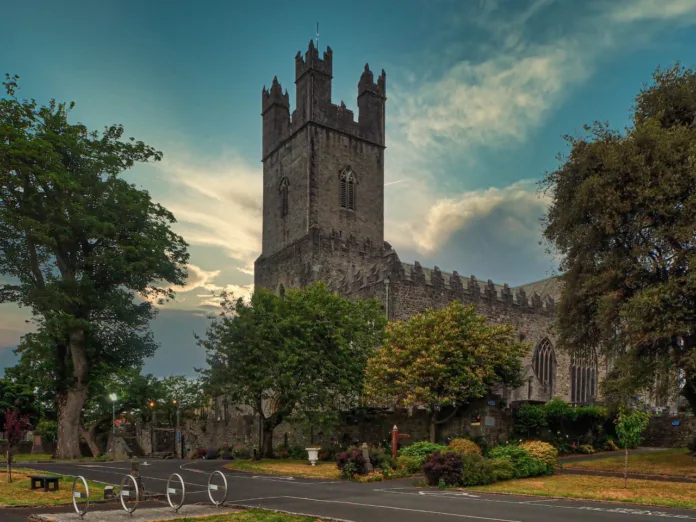
Of course, Silloway and Powers were not here to look at the grid of the newer city but the city’s cathedrals. They soon located the imposing iron gates of St Mary’s Cathedral easily from their lodging, taking a route down the main streets and across Matthew Bridge. They noted the burial ground in front of the building, and that “the dark and antiquated look of the old, massive structure impressed us favorably, and touched the right chord.”
As accustomed to modern architecture, they wrote that they were “hungering for something ancient in which the living present was playing its part, and nothing feeds this hunger so well as a cathedral”. Unlike the ruins of castles and abbeys they had seen elsewhere, this cathedral felt alive.
Gaining entrance, however, proved challenging, as a demonstration was taking place outside the gates, overlooked by a verger high in the cathedral tower. Once the demonstration passed, the verger, a “portly man of some 60 years” appeared before them. He quickly gathered they were American and looked for a tip of a shilling from both, even as they made their own way around the grounds.
Silloway and Powers’ tour of the interior was cut short due to construction works, although they did pause in front of the memorial of Samuel Barrington, ancestor of the celebrated Barrington family. The memorial noted his humble beginning as a clock and chime maker in the city. His descendants would rise to become knighted landed gentry whose philanthropy would see the establishment of Barrington’s Hospital.
Asking to climb the tower, they were informed by the verger that the fee increased by another shilling each. While the men enjoyed the view over the city from the tower, they were in fact far more interested in the bells it housed, noting that “wherever the English language is spoken, these bells receive honourable mention … There are eight of them, each hung with a wheel to aid its ringing. Four of them are old, and the others comparatively new.”
Today, a plaque in St Mary’s Cathedral tells of the recasting of five of these bells in the 1930s at the expense of William E. G. Hewson, Ballyengland, County Limerick. These bells were originally cast in different centuries, the Tenor in 1673, Treble and Second in 1703, Seventh in 1873 and Fourth in 1907. Hewson also included a new Call Bell in his donation.
Silloway and Powers only refer to the Roman Catholic cathedral of St John’s with a very a brief remark, noting it was “completed in 1860, is a Gothic edifice, erected at a cost of $85,000.” St John’s Cathedral was not officially consecrated until June 1894, by Most Rev Edward Thomas O’ Dwyer.
Turning their attention from the great limestone cathedrals, the men wandered toward the castle, “a somewhat dilapidated, but still noble structure. It has seven massive towers, which are connected by a wall of great thickness, and affords an example of the best Norman strongholds of the country, if not of the world.” They recounted Limerick’s role as the last city to surrender during the Cromwellian and Williamite sieges, and mentioned how the Treaty “guaranteed to Roman Catholics certain religious privileges and rights, and promised amnesty to all who took the oath of allegiance; but it was afterwards, to the disgrace of the victors, recklessly broken.”
They also observed the dilapidation of parts of the English and Irish towns, remarking that, “here are narrow and unclean streets, and a low grade of population, many of whom live in destitution; though, so far as degradation is concerned, we found less than in Cork.” It was obvious to them that the owners of buildings preferred to let them fall apart with time instead of dismantling them and rebuilding a new structure.
Wandering away from the ancient buildings, Silloway and Powers began to notice local business and business people. It was clear that the wealthier merchants had relocated from the English and Irish town to the new Georgian centre. Where the “principal industries of the place are the manufacture of flax, army-clothing, lace, and gloves. The city carries on an extensive traffic, and, having hundreds of well-stocked stores.” These stores supplied in part by the large harbour.
As well as the cathedrals, the authors noted that there were over 20 places of worship within the city limits, as well as many charitable and educational institutions. They concluded that the city as a whole “save the old and slummish portion, which is not of very great extent, and is under comparatively good control, it has a thoroughly English look, or, perhaps we may say, an old American look.”
As a final thought, Silloway and Powers chastised themselves for listening to the negative opinions of others about Limerick. They wrote that they “greatly enjoyed our visit … for our minds were disabused of opinions we before erroneously entertained, and supposed to be true, concerning this famous city.”