


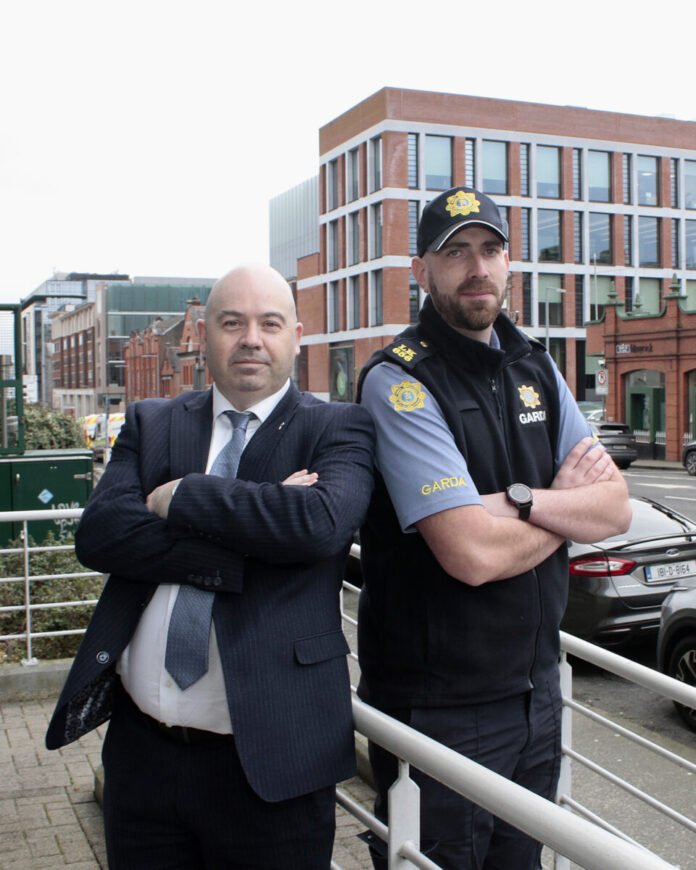
LIMERICK Garda Brendan Carmody always wanted to become a member of An Garda Síochána. Growing up, he tuned into episodes of Crime Call, but never imagined that one day he would follow in his heroes’ footsteps and make his own television debut as a member of the force.
Over the past four weeks, Garda Carmody was one of many Limerick frontline Gardaí to feature on RTÉ crime documentary series On The Beat.
The series offered an unfiltered look at the challenges facing An Garda Síochána with unprecedented access to Limerick’s Garda stations and control centres.
Speaking to the Limerick Post, Mr Carmody said the series “shows the public exactly what kind of situations we deal with on a daily basis”, with a particular emphasis on the drugs crisis within the city.

Garda Carmody began his career in 2019 in Tallaght, before moving to Henry Street Garda Station in 2023. Since then, he has worked in community policing in King’s Island and St Mary’s Park.
The rise of crack cocaine, a prominent issue for the city highlighted on the RTÉ series, is a problem Mr Carmody is all too familiar with.
“It’s a tough area and unfortunately there is a lot of drug dealing and anti-social behaviour. On a daily basis, I see young people between the ages of 13 and 16 dealing drugs. But we are also trying to build a positive relationship with members of the public in those areas too, to show that they can approach us and that we are approachable.”
Garda investigations rely on members of the public to come forward with information that may help in charging criminals and gathering enough evidence to bring offenders before the courts – a task that can be difficult on account of the fear of retaliation in communities from criminals and organised crime gangs.
According to Garda Carmody, “crack cocaine has the city ruined” with people tapping for money an all too regular occurrence on the streets.
The rising drugs crisis was just one of several issues featured heavily during the RTÉ series,
Behind the scenes, Inspector Vincent Brick, responsible for the Protective Services Unit in Limerick, helped coordinate the series locally. He explained that across the four one-hour shows aired, over 4,000 hours of footage was recorded in Limerick alone.
The seizure of e-scooters and scramblers also featured as a major issue for Limerick Gardaí.
During just one operation last July, 17 vehicles were seized in Limerick City by members of Henry Street Community Policing, including five motorbikes/scramblers, 10 e-scooters, and two small quad bikes.
However Inspector Brick says that despite law enforcement and legislation from Gardaí and the courts, “there is no way to police your way out of these kinds of societal issues”.
“Who is buying and paying for these bikes? I can go around to any area in the city on Christmas morning and I will meet young fellas on scramblers worth a couple of thousand euros. There’s a bigger educational picture here,” he says.
“Is it right to be giving young teenagers a mechanically-propelled vehicle that can inflict or cause serious damage to them or harm to them or to people around them?”
Investigating these crimes, particularly if the person committing the offence is a juvenile, poses another suite of challenges for Gardaí, especially when it comes to bringing an offender before the courts.
Courts hands are tied for young offenders
During the second episode of the show, Sergeant Rob Sheehy describes a group of up to 15 youngsters aged between 12-16 years old stealing cars across the city.
Despite a decrease in reported vehicle thefts in Limerick, the Treaty is the third most affected city in Ireland for car thefts after Dublin and Cork.
“There’s a long process in initially getting permission to bring them (minors) before the courts, and an even longer one to prosecute them in courts, because there’s specialist hearings within the courts regarding where things should be heard,” Sergeant Sheehy explains.
This process also involves Gardaí gathering all evidence, such as DNA and CCTV footage, seizing exhibits, securing search warrants, and being granted permission to charge a juvenile before the courts.
However, if a space is not available at Ireland’s only youth detention centre, Oberstown in Dublin, at the time a juvenile appears before the court, the young offender will simply go home.
“It’s frustrating for us, but especially for the victims of a crime. How do you tell a victim we’ve caught the perpetrator and brought them before the courts, but there’s no bed for them?” Detective Brick asked.
“The courts hands unfortunately are tied if there are no beds available for juveniles,” he explains. “We’ve seen young fellas, even those featured in the show, and they would tell us during our interviews that they know when we arrest them that if there’s no beds in Oberstown, they will go home again that night.”
Despite the challenges, Detective Brick, who arrived in Limerick in 2006 during the height of the gangland feuds, remains optimistic about policing across the city.
When asked whether Gardaí are concerned about reports of rising tensions amongst some of these groups in recent times, he maintained that “tensions are always simmering away”, but that the people of Limerick have demonstrated “great grit and a determination to get things done”.
“We saw that in 2006-2007 when Limerick took to the streets and said no, they weren’t tolerating this. Ever since then, we have never been found wanting as an organisation. When we ask for anything from other agencies like Limerick City and County Council, traders, the HSE, or just members of the public, we are supported.”
All episodes of On The Beat can be viewed on the RTÉ player. Filming for season three is set to commence in the coming months, with more frontline Limerick Gardaí to feature.
– Courts Reporting Scheme