


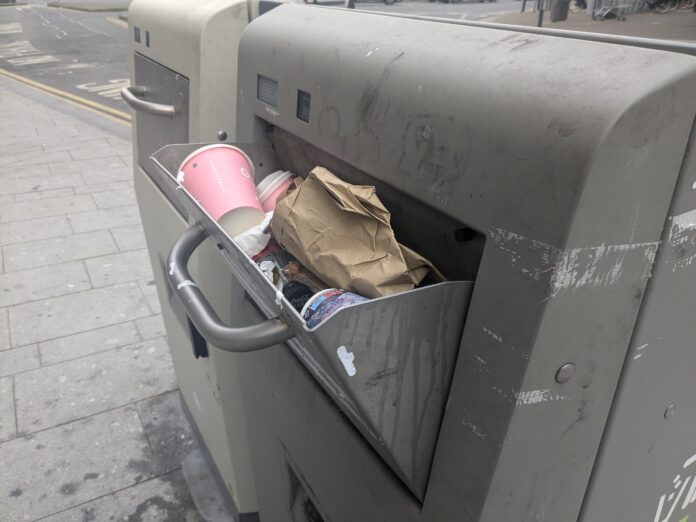
LIMITING household waste collections to just two days a week was one of the preferred options suggested for Limerick City at a recent local authority meeting.
Last October, KEO International Consultants was commissioned by Limerick City and County Council to undertake a study focusing current challenges in the city centre’s waste management system.
The Dublin and Galway-based consultancy firm, who made a presentation to members of the Council’s Climate Action, Biodiversity, and Environment Strategic Policy Committee, said it looked at potential options for improving the storage and presentation of waste in Limerick City.
According to Edward Wilkins, KEO senior project engineer, Limerick’s current private open market waste collection model results in several challenges, such as bins being left on streets on several days throughout the week.

“There are a sea of bins within Limerick’s laneways and footways in front of Limerick’s historical properties. Recently, or in the past year or so, there have been several issues relating to scavenging for plastic bottles and cans linked to the deposit return scheme and, as a result, litter bins falling into a poor condition have really emerged as additional challenges,” Mr Wilkins told the meeting.
Cristina Harber, KEO waste management specialist, explained the company analysed options that take into account the different types of properties and areas in Limerick.
The first option envisaged designated collection days to limit household waste collections to just two days collections per week.
“The bins will be on the street only on those designated days. This will also encourage the service providers to be more efficient in how they manage collections or time, and could potentially develop some natural territorial patterns,” Ms Harber said.
“However, this option wouldn’t work in busy commercial areas with daily collections, but could be effective in residential areas where collection happens less often.”
Option two suggested restrictive time scheduling to a tighter window to reduce the collection time from 50-hours to two-to-five hours per week to encourage bin collectors to coordinate operations.
The consultants, as part of their feasibility study, looked at what other cities across Ireland and Europe are doing in terms of storage and presentation, Mr Wilkins added, “also looking at potential alternative individual storage systems, whether that be the use of bags or reusable sacks or smaller containers like caddies and crates”.
“We’ve also looked at different sheds or communal container options and how they might work or not work in Limerick City Centre and then on the more costly side of things as well, we’ve also considered underground storage solutions and other higher tech options.”
KEO said there was “no silver bullet” for all streets and properties within the city, recognising the Treaty City’s history and different types of streets and buildings, suggesting that each property has its own potential solution.
“After reviewing the pros and cons of the different options within the specific context of Limerick, our recommendation would be to stick with the two main streams, residual and recycling, but to enable members of the public to have a separate attachment or a separate container for those plastic bottles and cans that are causing so many challenges at present,” the meeting was told.
“This type of system is already being rolled out in Dublin successfully, and we see it being a potential solution that could add value within Limerick as well.
“At present in Limerick, there’s a whole range of different types of bins and different designs of public realm bins within the city centre. One key recommendation would be to focus on the kind of simple, more robust design, given the challenges with people breaking into bins and the maintenance issues that arise as a result of that.”
Labour Party councillor Joe Leddin agreed the consultants in relation to collection days, pointing out that “we are not New York City, we’re a metropolitan city of a 100,000 people”.
Having multiple bin providers operating in the city on the same day, he opined, is no longer feasible going forward.
“We absolutely have to look at different options and potentially the option of the Council issuing a tender to streamline the collection process because the current system is not working,” Cllr Leddin insisted.
“They can come in any time of the day, any day of the week at present, and it is absolute chaos,” he added.
Fianna Fail councillor Joe Pond said the waste management system throughout the Metropolitan District needs to be streamlined, adding that “families are advised to shop around for a bin service, but Annacotty alone has three different collectors coming into the village over a week. The bins are out Monday night, Wednesday night, Thursday night. It needs to be streamlined.”
Fine Gael councillor Sarah Kiely reminded councillors that they had already decided their 2026 budget allocation and, unless a “pot of gold” was found for bin storage, they would not be able to move it forward.
Social Democrats councillor Shane Hickey-O’Mara supported Cllr Kiely’s call for funding for bin storage but raised his own concerns about where this money would come from.
The Council’s Head of Environment, Aidan Finn, said the point about finance was well made, and one already raised by management during their internal consultation for a new waste management system.
“This is a consultation process. We’re in the middle of it, this is not the final phase, it is not a fait accompli. This is basically getting feedback from councillors so we can make some decisions going forward,” he concluded.
– Local Democracy Reporting Scheme