


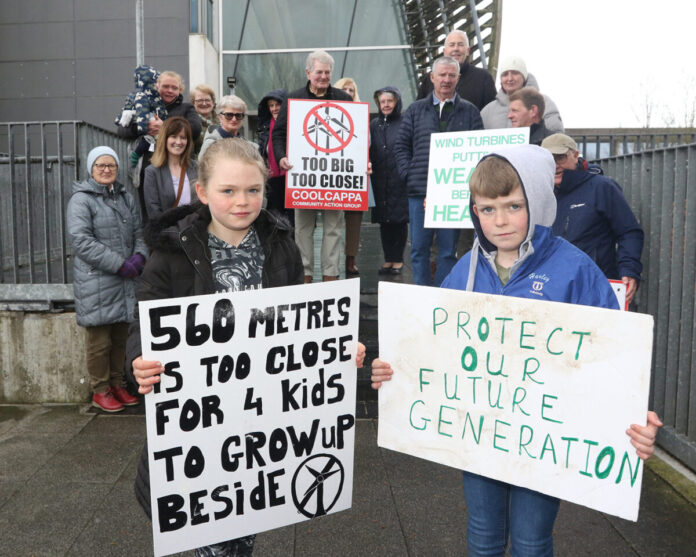
LIMERICK City and County Council has refused planning permission for a proposed wind-farm development at Coolcappa, West Limerick.
However, a group who were opposed to the proposal said that, although it was happy that planning was refused, it was going to appeal the decision on the grounds it could have been “stronger”.
The Council cited three main grounds for its refusal of the six wind turbines and associated works, including a lack of information from the developer on the potential impact of noise on the community as well as the potential material/visual impact on local protected structures and cultural heritage, and a lack of detail on the potential impact on the local road network.
“It’s a good decision, but it could have been stronger — noise is a public health issue, not just an annoyance, and this has been ignored. We now have no choice but to appeal for a decision that properly protects people,” said Brenda Dowling, spokeswoman Coolcappa Community Action Group.

“This isn’t about saving the planet – it’s about business, and right now public health is being sacrificed. Our children’s health is at stake,” claimed Ms Dowling.
Some people living locally were supportive of the development being built on their land for an annual fee.
Local Fine Gael councillor, Adam Teskey said: “The local authority has made its decision on what was presented to them.”
“It has been a long, long process, and it has been a source of major concern for the people of the area that I represent.
“The community at large will welcome the planning refusal, however, it is the applicant’s statutory right to appeal a decision of this nature, so that avenue remains in the background here, but for now, the Council’s decision will, I think, be welcomed by the majority of the public.”
Locals said they expected the developer, Ballynisky Green Energy Ltd, with a trading address at Tralee, County Kerry, will appeal the Council’s decision.
When contacted for comment, Ballynisky replied: “We are currently considering the Council’s decision with our advisors.”
The proposed turbines have a tip height of 158 metres and a hub height (tower) 90 metres.
Over 400 objections were lodged prior to the Council’s decision to refuse planning.
Coolcappa Community Action Group objected to the proposed windfarm over fears it would have a detrimental impact on human health in area.
The group cited concerns around the impact of “noise pollution” and “shadow flicker” on their health and livelihoods, and said it feared that if the wind farm was given the green light, local homes would be completely “devalued”.
They claimed “shadow flicker is a nuisance and effects health, causing eye strain, headaches, and nausea, and is a serious concern for people diagnosed with epilepsy”.
They also claimed that 2019 draft planning guidelines state that shadow flicker must be eliminated in line with HSE environmental health recommendations.
When previously contacted for comment, a HSE spokeswoman said: “There is currently no robust evidence to show that wind turbines negatively affect people’s physical health once they are appropriately installed in accordance with guidelines.”
The Coolcappa Community Action Group have also called for tighter “regulation of wind farms” nationally as “people are suffering across the country”.
Other objectors complained they had not been adequately consulted by the developer.
In a prior response to these complaints, Ballynisky Green Energy Project said it had engaged in “extensive consultation” with the community from November 2022, which it said involved a public exhibition, door-to-door visits, information leaflet drops, and newspaper advertisements.
Ballynisky stated in March 2024: “We can assure the community that the planned turbines are designed with technology that ensures no shadow flicker will be experienced at dwellings or other local amenities.”