


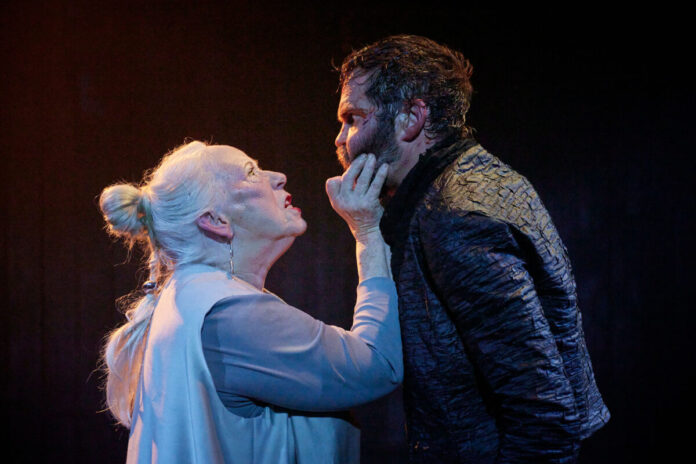
THE multi award winning Marty Rea has played many complex roles in his career, but few as demanding — or as richly rewarding — as the murderous Scottish general at the heart of Druid Theatre’s critically acclaimed production of Macbeth, which comes to Limerick’s Lime Tree Theatre later this month.
Directed by Tony Award winner Garry Hynes and featuring fellow Tony Award winner Marie Mullen as Lady Macbeth, the production earned rave reviews during Druid’s 50th anniversary year in 2025. Now, Rea reflects on what makes this particular Macbeth so distinctive — and why Shakespeare’s darkest tragedy feels so at home in Irish hands.
For Rea, the key to unlocking Shakespeare lies not in narrative but in music. “The actual rhythm and sound and pacing and meter of the words, how they’re put together — it’s almost like a musical score,” he says. “Shakespeare never wrote an original plot in his career, except for The Tempest. They were all known stories. What makes them particular is how he tells them, and the secret is in that rhythm.”
He describes the experience of performing Shakespeare as something that works on a near-physiological level. “The rhythm makes you breathe in a certain way. It affects you. It emotionally guides you through. And you kind of have to have the courage to let it happen and try and get out of the way of it.”

The production brings an unmistakably Irish sensibility to the Scottish play, though Rea is careful to frame that quality as something organic rather than imposed. “It’s not that we’ve put anything deliberately Irish into it. It’s just being spoken in Irish accents and thought of by Irish brains. Then it’s going to be an Irish take on it — but the story suits us very well.”
Part of what makes it suit Druid so well, he suggests, is a shared cultural inheritance. “As a Celtic people, we know how close religion and the pagan rub up against each other in Celtic nations and Celtic communities.” That tension — so central to Macbeth’s world of witches, prophecy, and moral collapse — feels, he implies, less like history than lived memory.
The casting of Mullen as Lady Macbeth opposite Rea carries its own resonance. The two previously shared the stage in Tom Murphy’s The House, and Hynes has drawn on the dynamic of that earlier pairing — its complications, its charged imbalance — to inform the relationship between Macbeth and his wife here.
Hynes herself has spoken of Shakespeare as a relatively recent but deep passion for Druid, and Macbeth in particular as a play she had long wanted to tackle. “Garry enjoyed doing a lot of work with Shakespeare in the last decade,” says Rea. “She wanted to go back there again, because the best plays are going to give you great ideas, great productions. Macbeth was on Garry’s radar since she was a student.”
What endures, for Rea, is Shakespeare’s fundamental understanding of human nature. “His plays never go out of fashion,” he says simply. “He was so brilliant at understanding what it is to be a human being.”