


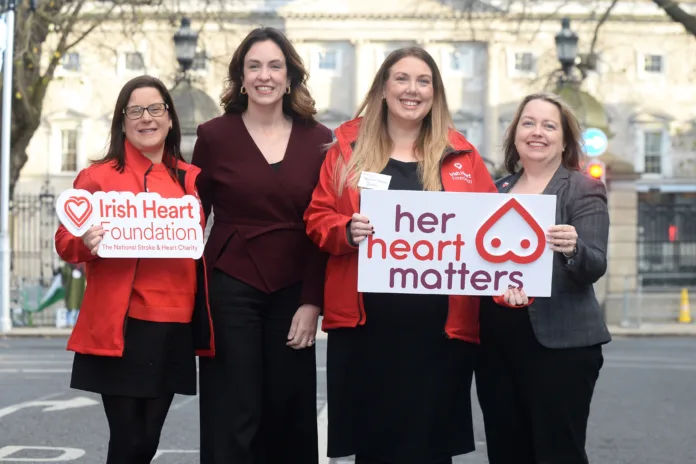
A CONSULTANT cardiologist from University Hospital Limerick addressed an Oireachtas Heart and Stroke Group meeting, which called for targeted action to advance research into women’s heart health.
Consultant Cardiologist Dr Neasa Starr highlighted how women are under-represented in policy, clinical guidelines and medical education.
An estimated 277,389 women are currently living with cardiovascular disease (CVD) across Ireland, including 11,191 in Limerick.
Attendees also heard from Irish Heart Foundation Director of Health Promotion, Janis Morrissey.

CVD is the leading cause of death among women worldwide and claims a quarter of all female lives in Ireland.
The Oireachtas Heart and Stroke group was set up by Clare TD Cathal Crowe and his constituent and Irish Heart Foundation, Advocacy Campaign Manager, Pauline O’Shea, who herself is a heart patient living in Ardnacrusha.
It aims to build consensus across the political spectrum to support heart and stroke patients and thereby deliver huge reductions in preventable death and disability.
“Cardiovascular disease claims one in four of all female lives, yet it remains under-researched, under-diagnosed, and under-treated,” said Janis Morrissey.
“We need targeted action to advance research into women’s heart health, improve prevention and diagnosis and ensure equitable access to the cardiovascular care they deserve.”
Attendees at the meeting heard that women’s heart health has been under-represented in national policy, clinical guidelines and medical education.
Often seen as a male health concern, women face a lifetime risk similar to men, but studies show that their symptoms are frequently overlooked, misinterpreted or dismissed.
Women with heart failure take an average of five weeks to receive a diagnosis compared with three weeks for men and they are twice as likely to be diagnosed only after attending the emergency department.
Women are more likely than men to experience atypical heart attack symptoms, including nausea, shortness of breath, fatigue, and pain in areas such as the jaw or back.
These symptoms are often misattributed by healthcare professionals to stress, anxiety, or indigestion, which can delay treatment and, in some cases, be life-threatening.
Although the Department of Health’s Women’s Health Action Plan commits to improving women’s health and addressing systemic inequities, the national charity for heart and stroke disease has said gaps remain.
It pointed to the need for investigation in sex-disaggregated data, research prioritisation and the integration of female-specific evidence into practice and policy.
The Oireachtas Group has called for targeted action on prevention, early detection and management of risk factors, education and awareness, access to data, research and medical training.
It also called for more timely diagnosis and awareness of the invisible struggles women can have in securing the supports they need to live well post-diagnosis.