


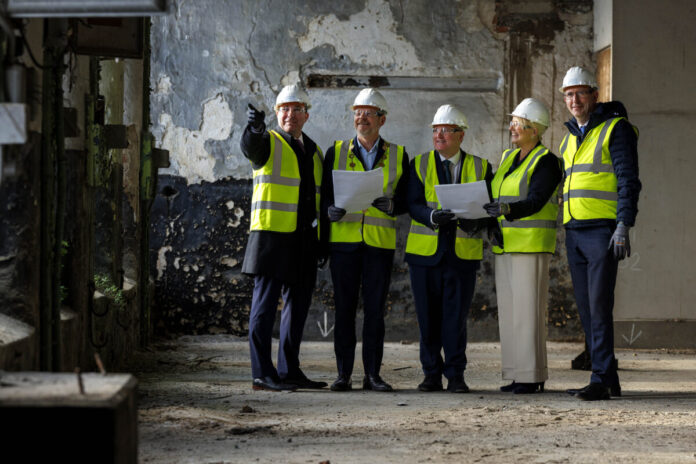
THE FIRST steps have been taken on a €400million landmark city project that will create a new urban centre on the one of the most important historic sites in Limerick City.
Works have started on the first phase of the Cleeves Riverside Quarter regeneration, marking a major milestone in the transformation of the historic 10-acre project in the heart of Limerick.
When the scheme is completed, it will become a major centre for academia and education, with student facilities, commercial spaces, new parks, plazas and gardens, including the reservoir/quarry park, Flaxmill Square, and a riverside corridor connecting the site to the wider city.
Limerick Twenty Thirty (LTT), the Council-owned company driving the project, submitted a planning application in November for the second phase of the project, while will be the first major ‘build’ phase.

The planning application provides for the delivery of a mixed-tenure residential and student neighbourhood accommodating around 1,000 people, including 234 homes and 270 purpose-built student rooms.
The development will support both city-scale events and everyday recreation, with opportunities for water-based activity arising from the on-site reservoir and proximity to the River Shannon.
Sisk has been appointed as contractor to deliver the first phase, which will focus on the stabilisation, consolidation, and repair of the protected 175-year-old Flaxmill building, one of Limerick’s most significant industrial heritage structures.
The works, which will run for 15 months, are being delivered with funding support from the Urban Regeneration and Development Fund (URDF).
The protected Flaxmill building is one of Limerick’s most significant industrial heritage structures, and its age and condition require a careful, conservation‑led approach to repair and stabilise the building.
Built around 1853, the site is a rare surviving example of nineteenth‑century industrial architecture and forms a central element of Cleeves Riverside Quarter.
LTT appointed a specialist conservation team led by Feilden Clegg Bradley Studios (FCB Studios), an internationally recognised UK‑based practice known for its work on historic and protected structures.
Working alongside Cappamore‑based Architectural Conservation Professionals, the team has undertaken detailed surveys, investigations and design development over several years.
Welcoming the first steps on the new city quarter, Limerick TD and Minister of State for Older People and Housing, Kieran O’Donnell, said “the works to the Flaxmill as a protected structure are a crucial first step in unlocking the full potential of the site and I look forward to seeing the project progress and the benefits it will bring to the new Cleeves Riverside Quarter and Limerick City for many years to come”.
Mayor of Limerick, John Moran, added that the moves mark “another important milestone for Limerick as we continue to build momentum in delivery”.
“Beginning work on site will secure the future of the Flaxmill building and ensure it’s brought safely into the next phase of Limerick’s development.”.
James Collins, chairman of Limerick Twenty Thirty, described the news as “hugely important moment for Limerick”.
“This building is an integral part of the city’s industrial heritage, and these carefully planned stabilisation and repair works ensure it will be protected, respected, and repurposed as part of a vibrant new city quarter.
“With works now underway on site and planning lodged for phase two, the project is moving decisively from vision to delivery. This is a major step forward for Limerick City Centre and for the sustainable reuse of our historic assets.”
Director General of Limerick Council, Dr Pat Daly, said that the works will help safeguard “a treasured piece of Limerick’s industrial past, but also lays the groundwork for the vibrant new neighbourhood we are creating at the heart of the city”.
“By investing in our heritage today, with support from the Urban Regeneration and Development Fund, we are creating the conditions for economic vitality, social connectivity and a stronger region.”