


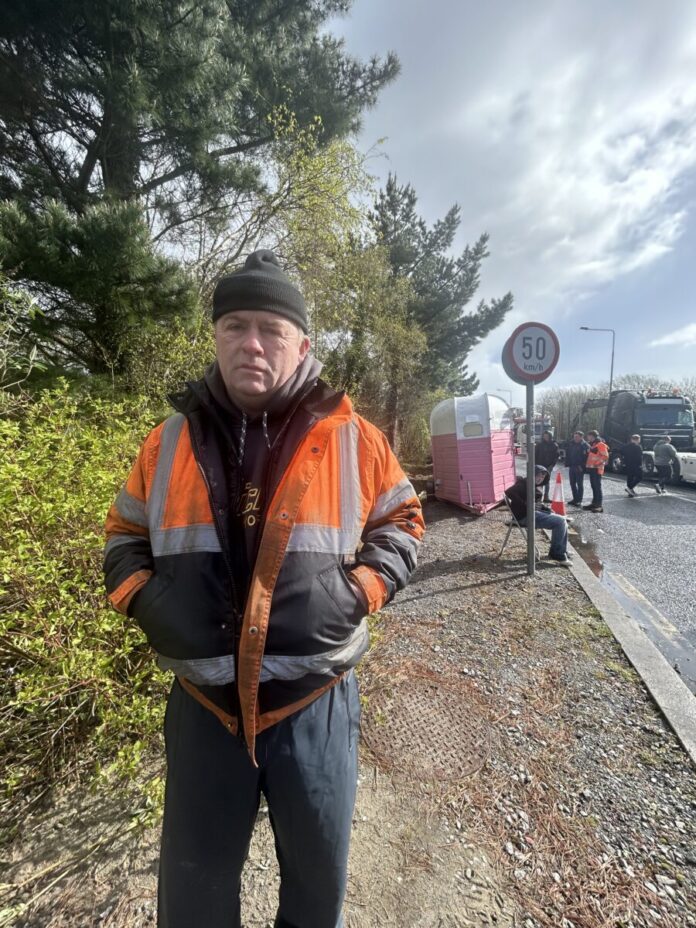
A MEMBER of the fuel protest at Foynes, County Limerick, said his 40-year-old family-run plant hire business was hanging on a thread over “crippling” fuel costs.
Speaking this Saturday at the front line of the fuel protest blockade at Foynes, Martin Sheahan said: “I’m under ferocious pressure with the way the price of fuel has gone and it is crippling the country.”
“We need our government to try and sort out this and give us a break and try and keep the country afloat,” he offered.
Mr Sheahan said he operates “a few diggers on the road and a couple of trucks” but he had temporarily turned off the engines on his machines as the cost of running them was too high.

“It’s just getting harder every year, I’m 39 years on the road, and this has been the hardest year that I have met.
“Fuel (cost) is absolutely crippling us, and it is essential to what we do, the machines won’t go without it.”
Sheahan, a father of two, said his two sons are involved in the business too, and that their livelihoods were also under threat due to the current price of fuel.
“We will remain here at Foynes until we get answers, we are here for a long haul,” he pledged.
“The public are very good to us here, we have good backing, and great friends coming here bringing us food and looking after all the lads here. We are well in with the public and the public need support as well.”
Sheahan’s message to the Government was a simple one: “Please sort out this fast, we can’t stick much more of this (fuel price), and if it continues, there will be auctions of machines, lads will have to sell out and businesses will be gone.”
Independent Ireland TD for County Limerick, Richard O’Donoghue, who was on the ground supporting the blockade, said that following consultation with local Gardaí, an agreement had been reached allowing five fuel trucks to leave the Foynes terminal, as well as trucks carrying animal feed and chemicals for water treatment plants.
“The Foynes protest has been a very peaceful protest, there has been open dialogue (with Gardaí) from the very start,” said Deputy O’Donoghue.
“These people don’t want to be here, there are nurses here and Gardaí, mothers and fathers and children. They are here because the Government haven’t listened to them when they said they are at their wits end.”
Motorists passing the blockade beeped their vehicle horns in support of the protestors and donations of hot food, refreshments, anoraks, and umbrellas continued to pour into the blockade camp to keep protestors warm, dry, and fed.
Deputy O’Donoghue said he expected that a number of people involved in the blockades, who had never run in political elections prior to the blockades, would run against Government parties at the next general and local elections.
In a message to the main coalition government parties, Fianna Fáil and Fine Gael, Deputy O’Donoghue said: “Your existence is going to be gone after this, because these people are going to put up candidates across the country.”
“We have had enough, these people don’t have any faith in the governance of this country anymore and they don’t believe any person in government at the moment represents the people of Ireland.”
Protesters said the Foynes blockade would continue until their demands, which include a fuel price cap, are met.
A management meeting of the HSE Mid West heard that it was taking some staff up to six hours to get to and from work in the region as a result of the fuel protests on roads.
Fianna Fáil TD Niall Collins told local radio station Live 95 that the fuel protest on roads had directly resulted in a cancer patient spending four hours in their car after they had chemotherapy at University Hospital Limerick.
“This is having huge ramifications for people who want to go about their normal daily lives,” said Deputy Collins.
Richard O’Donoghue said an agreement had been reached to allow Gardaí and other emergency services access to fuel at the Foynes terminal.
Some of the fuel that left the terminal Saturday was destined for a filling station in Limerick City, emergency service vehicles, and fuel required for the food processing sector.
However, the majority of fuel filling stations across the region remain empty or at critically low fuel levels.