


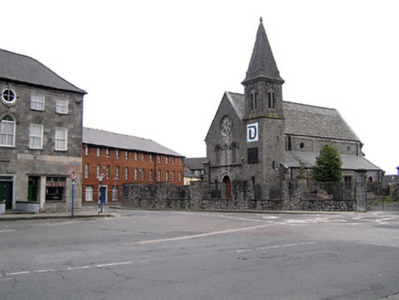
SIXTY years after the 1691 Siege of Limerick, the city entered a period of peace and prosperity. The turbulence of the late seventeenth century gradually receded into memory and the walls that once surrounded the city were decaying, with plans afoot for their demolition, writes historian Sharon Slater.
Among those most closely associated with this new phase of urban development was Edmund Sexton Pery, a figure whose influence upon the physical and social landscape of Limerick cannot be overstated.
Born in 1719 and trained in the law, Pery rose to prominence as a barrister before entering public life. In 1751, he was elected to the Irish House of Commons as Member for Wicklow, though his principal interests and loyalties remained firmly rooted in his native city of Limerick.
Today, his name is most readily connected with the creation of Newtown Pery, the elegant Georgian district extending toward the River Shannon, whose broad streets and orderly terraces stand in marked contrast to the medieval irregularity of the older town. Yet this celebrated undertaking was not his earliest venture in urban planning.
In that same year of 1751, Pery turned his attention to lands he had inherited in the parish of St John, situated to the east of the ancient city. Pery did not work alone on this project. He went into partnership with John Purdon of Tinerana near Killaloe, with the shared ambition of creating a residential development. They hired architect Francis Bindon (1698 – 1765) to design the planned square.
This era in Limerick history saw a rise in local aristocracy and gentry, who had both large summer homes on their estates as well as city homes where they would stay during the winter months and while on business in the city. The old districts within the walls of Englishtown and Irishtown were dirty and overcrowded. Every inch of land, including the space on Baal’s Bridge, was used for housing. There was nowhere for this new fashionable set to stay.
The New Square, as it was originally called, was created to address this need. The development was quickly renamed St John’s Square due to its proximity to St John’s Church (Church of Ireland), but it is more commonly known as John’s Square.
Bindon’s original design consisted of two L-shaped blocks of limestone-fronted houses, each one identical to its neighbour. The initial build cost £630 to complete. There were originally eight houses (with a further two subsequently added) built on three sides of the square. All 10 of the houses were three storey over basement.
Pery and Purdon kept a building to themselves and the other houses were let at £32 per annum. Original tenants included Vere Hunt of Curraghchase, William Monsell of Tervoe and Pery’s brother, the Rev William Cecil Pery. Another of the early tenants was Dorothea Crump, widow of General Crump, who later married to William Cecil Pery. William succeeded his father in the vicarage of St John’s Church, which occupied the fourth easterly side of the square. William Cecil Pery would later become the Protestant Bishop of Limerick.
At the time of the new construction, the 15th century church of St John’s was very much in use, protected by walls built in 1693. It would take another hundred years for eyes to be set on the church for redevelopment.
Controversy amid reconstruction
In 1851, Rector John Elmes, who lived in one of the houses of John’s Square, set about the construction of a new church, but not without issue. That year he was accused of exhuming human bones from the churchyard and moving them to the pig market. On June 23, 1851, a committee report on the accusations chaired by Mayor of Limerick, Thaddeus MacDonnell, was released.
The committee found that the greater portion of the church yard had been levelled by the removal of the surface of various depths, that a large portion of this surface containing the bones of the dead had been removed to the old pig market in the vicinity of the artillery barracks, and that this occurred over the entire graveyard except where prevented by large tombs.
The committee also noted that the graves of several citizens were uprooted, and in some instances the coffins removed to other parts of the church yard where removal was practicable, but that the coffins too fragile to unearth were buried in heaps. Finally, it was noted that in some parts all traces of the burial place of certain families was obliterated by the removal of the tomb stones, and that headstone and tomb stones were piled over each other with no discernment as to their original placement.
Despite the uproar from the locals and those in the Limerick Corporation, Rev Elmes continued with his plan to clear the site for the building of the new church. The work on the new church and churchyard ended the following year.
The present church was opened on June 24, 1852. Within a few short weeks the new pillars at the entrance to the church were plastered with an inflammatory election placard. Rev Elmes took umbrage at this and had one of his employees remove it.
A few minutes later, a mob of some hundreds came rushing on and severely beat the man who had removed the placard. Mr Elmes went amongst them and brought the man into his house, but the crowd continued to increase and used violent and threatening language. Mr Elmes’ two sons and the parish schoolmaster went to the magistrates for the police, and the answer they brought back was to summon all the offending parties.
‘One sees the mud, and one sees the stars’
Rev Elmes continued as rector of St John’s Church. In 1869, he passed away in the rectory, John Square. He was buried in the churchyard that caused so much controversy 18 years earlier. His headstone remains and reads: “Sacred to the memory of Revd John Elmes. The beloved minister of this parish for 31 years. Under whom the present church was rebuilt. He died Jany 5th 1869 aged 63 years.”
The last rector of St John’s Parish who lived in John Square was Canon Frederick Langbridge (1849-1922). Langbridge was a novelist, poet, and dramatist most well-known for the line: “Two men look out through the same bars: One sees the mud, and one the stars.”
He was rector of St Johns for almost 40 years and, unlike his predecessor, he was well liked in the community. Even the poles outside St John’s Temperance Society were draped in black as his funeral took place.
While the church was deconsecrated in the 1970s and is now used by Dance Limerick, the graveyard is still in use with the most recent burial taking place in 2025.