


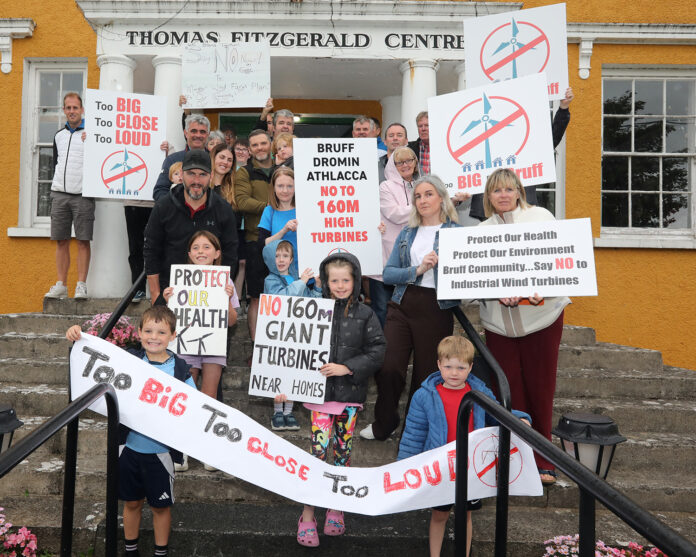
A LIMERICK mother has spoken of her concern for her family’s health, particularly one of daughter who has an autism diagnosis, if “mega” wind turbines are given the green light to be built near her home.
Marie Claire Power, from Bruff in Limerick, said she is “very concerned, I can’t predict how every child will react, but I believe it will have a negative impact particularly on children diagnosed with autism”.
The mother of two said there appeared to be a “huge prevalence” of autism in her local area and that she was concerned that noise and “shadow flicker” – a ‘strobe lighting’ effect associated with the shadow of the turning blades of turbines – would be overwhelming for people living with sensory conditions.
Ms Power said the current guidelines for developers in respect of noise, as one example, are “outdated” and not fit for purpose.

The developer, Ballinlee Green Energy, a subsidiary of Greensource Sustainable Developments Ltd, proposes to erect 17 wind turbines in the area, including one 650m from Ms Power’s home.
“If this happens, we are going to have 100 per cent exposure to these mega structures,” she said.
Ms Power is a spokesperson of a local group concerned that the development will negatively impact health and the local environment and devalue homes.
She said the group is “not opposed” to renewable energy developments, but they should not come at the expense of people’s health and homes.
The group argue the proposed giant turbines are “too big, too close, too loud” for the area and should be relocated.
The hinterland earmarked for the 160m high turbines sweeps around the town-lands of Dromin Athlacca, Bruff, and Ballinlee, however Ms Power said these areas are “lowland floodplains” and should not be considered for wind energy.
The group estimates that hundreds of homes could be impacted by the project.
Ballinlee Green Energy’s planning application is likely to bypass Limerick City and County Council’s planning department and go straight before An Coimisiún Pleanála as it is “a strategic infrastructural development” and the EU has directed Ireland to ramp up renewable energy developments.
The Bruff opposition group claimed there has been a lack of communication from the developer, who declined the group’s offer to attend a public meeting for locals to ask questions.
Ms Power said the developer held no public meetings, preferring one-to-one “clinics” with individuals rather than larger groups. She said these clinics are now being wound down as the company prepares to lodge it’s planning application.
In response, the developer said the project “would play a key role in supporting the government’s Climate Action Plan, which aims to reduce greenhouse gas emissions by 51 per cent by 2030 and achieve net-zero emissions by 2050”.
“This project alone has the potential to provide clean power for up to 42,000 homes and reduce harmful carbon emissions by approximately 75,000 tonnes each year of operation,” it said.
The developer responded that it was “committed to meaningful and transparent engagement with the community” and that it had advertised the project in a local newspaper.
It said it sent details of the development “to all houses within a 1km radius of the proposed project, and the community engagement team visited all houses within this radius” to host clinics allowing residents “the opportunity to have their voices heard”.
“The dedicated community team continues to be available for consultations, and engagement is ongoing.”
Ballinlee Green Energy said it was “preparing an Environmental Impact Assessment Report as part of its planning application, which contains a comprehensive noise and vibration assessment, which will confirm that the project will comply with all noise guidelines and relevant legislation”.
“This report will also detail that shadow flicker at dwellings will be eliminated, in accordance with the Draft 2019 Revised Wind Energy Development Guidelines.”