


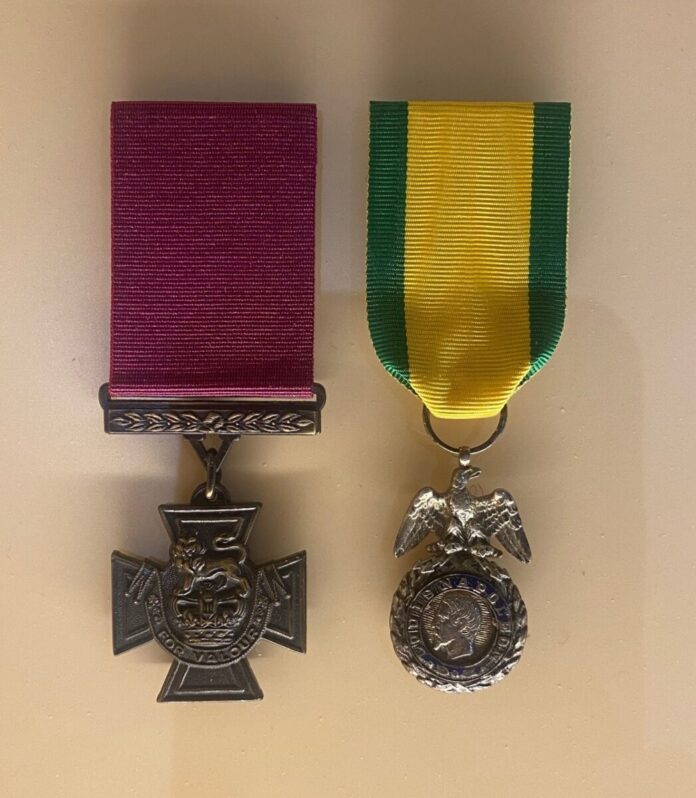
LOCAL historian and author Des Ryan has solved a 148-year mystery after discovering the long-lost grave of one of the earliest Irish recipients of the Victoria Cross.
Private Joseph Bradshaw VC, a native of Pallasgreen, Dromkeen, County Limerick, served with distinction in the Crimean War and the Indian Mutiny, Mr Ryan said.
He died in Dublin in 1878 and, until now, the location of his burial had remained unknown, with many publications incorrectly citing both his date and place of death.
Many believed he was buried at St John’s Church in Limerick, but following extensive archival investigation, Limerick historian Des Ryan says that Bradshaw is buried in an unmarked shared grave (EE196) in Glasnevin Cemetery, Dublin, where he was interred on March 23, 1878.

The Limerick historian says the grave is shared with at least six others and, unlike many of his fellow Victoria Cross recipients, no headstone or marker currently honours his service.
“I find it very sad that such an eminent and valiant Limerick man had spent almost 150 years in an unmarked grave. I would like to see a proper headstone put in place or better still, I’d like the Mayor to investigate repatriating him to Limerick and to enquire about having his medals brought home too,” Mr Ryan commented.
Born in May 1832, Bradshaw enlisted in the 2nd Battalion of the Rifle Brigade (Prince Consort’s Own) in 1853. He earned the Victoria Cross for his bravery during an assault on a Russian rifle pit on April 22, 1855, during the Siege of Sevastopol.
Bradshaw was given his medal by Queen Victoria at the first Victoria Cross Investiture, held at Hyde Park in London in June 1857. 62 awards were issued that day to Crimean War veterans – two of which were issued to men from Limerick, Joseph Bradshaw and William Coffey from Knocklong.
Bradshaw later fought in the Indian Mutiny, where he was again recognised for his courage and sustained serious injuries in action.
Despite his exceptional service record, which included the Victoria Cross, the French Médaille Militaire, the Crimea Medal, and the Indian Mutiny Medal, Bradshaw lived his final years modestly in Dublin, working as a watchman. He died from “disease of the liver” aged 42.
His medals, pawned by his wife in Dublin after his death, eventually became part of the Rifle Brigade’s collection and today reside in the Rifleman’s Museum in Winchester.
Mr Ryan’s discovery brings long overdue clarity to a hero’s final chapter and, he says, raises important questions about commemoration, recognition, and historical memory.
“This is an opportunity,” he added, “to honour Bradshaw properly and to ensure that future generations of Limerick people know his story.”