


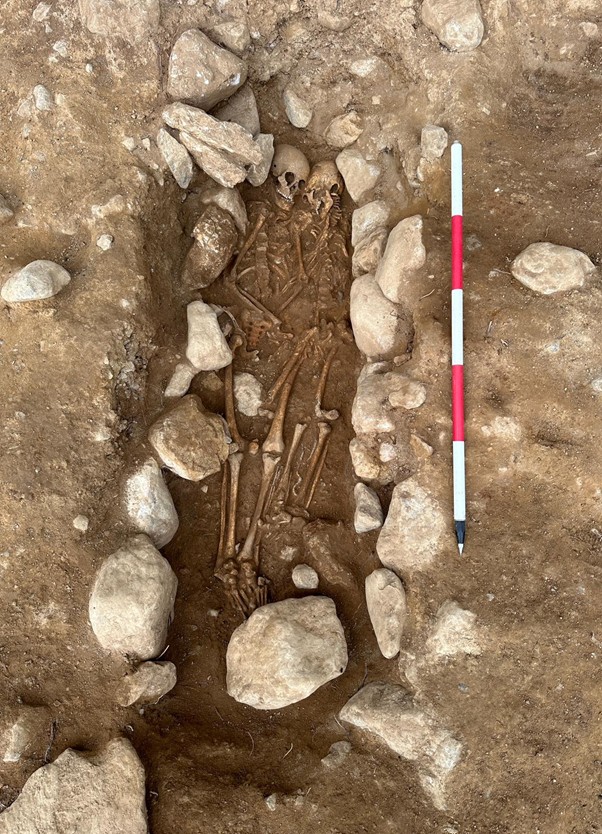
EXCAVATIONS of land along the route of the Foynes to Limerick/Adare Bypass road have unearthed human remains and ancient artefacts which give credence to the local name for the area – ‘The Field of Blood”.
Excavation director Seán Tiffin from Archaeological Management Solutions (AMS), who led the excavations at the circular mound at Croagh, was fascinated by what one local told him about the field in which he was digging, saying that “even before we had fully exposed the site here, we were told that the field was known as ”the Field of Blood’, and so we were on high alert even before the first human bones were encountered”.
Subsequently, dozens of burials, laid out in a Christian style, were encountered, one of which was adorned with a beautiful example of early medieval metalwork in the form of a carefully crafted buckle.
Initial examination of the remains by project osteoarchaeologist Dr Mara Tesorieri revealed multiple traces of wounds on some of the individuals, suggesting a number of those laid to rest there met violent ends, including by decapitation.

The remains are those of a society where warring was par for the course, fighting over land, or in many cases over cattle which were the main indicator of wealth.
There was also poignant evidence of non-violent but no less tragic loss, for example, with one burial where a woman and child were laid together, posed in a way suggesting a caring relationship between them.
Radiocarbon dating indicates that the burials largely date to the 6th-7th centuries. Analysis of the skeletal remains is ongoing.
Fintan Walsh, AMS excavation manage, said “this was only one of the 150 sites found on the project, all of which were fascinating in their own right”.
“These sites included prehistoric settlements, cooking sites, and burials; medieval forts and burial grounds; as well as lime and brick making kilns of our more recent past, and World War II (‘Emergency’) era concrete pillboxes.
“Built heritage surveys recorded vernacular houses, a quay keeper’s cottage, railway structures, and historic farm buildings too.”
Maeve Sikora, keeper of Irish antiquities at the National Museum of Ireland, said that “the archaeological evidence uncovered during excavations in advance of the Foynes-Limerick Project includes a spectacular array of finds from the prehistoric and medieval periods, attesting to the importance of this area through time”.
“Many of the finds are hugely significant, not just because they are rare, but because they were found in dateable contexts and can be used as reference points by researchers for many years to come.”
Fieldwork on the project is now coming to a close, with all excavations completed in advance of construction, including those on the Adare Bypass section, which were prioritised to facilitate the speedy development of the bypass in time for the 2027 Ryder Cup.
The team at AMS are now writing up their reports, all of which will be made available online through TII’s Digital Heritage Collections which forms part of the Digital Repository of Ireland.
In the meantime, to showcase their discoveries, AMS has launched an online StoryMap where all of the discoveries can be explored, which can be accessed via tii.ie/en/technical-services/archaeology/storymaps.