


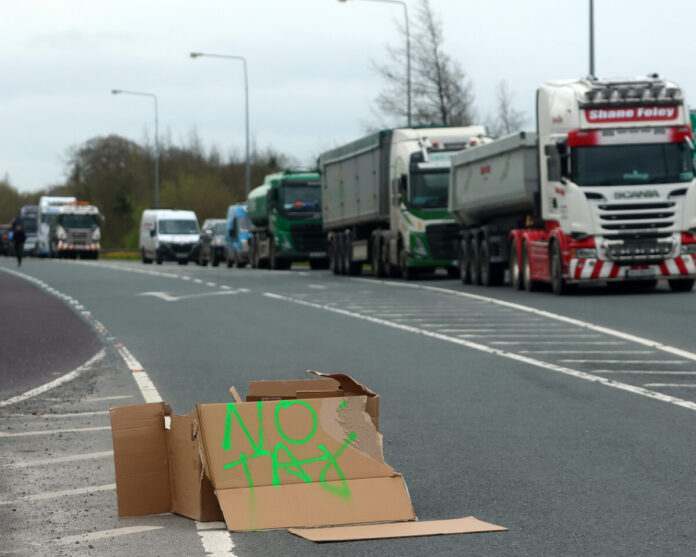
THREATS by the government to call in the Defence Forces to assist An Garda Siochána during last week’s nationwide fuel protests sparked huge controversy. Minister for Justice, Jim O’Callaghan announced last Thursday on the third day of protests that a formal request had been made to the Defences Forces to assist with policing the blockades that had cut off access to ports in Limerick and Galway, as well as access to the country’s only oil refinery in Whitegate. While the Defence Forces assisted operations, they remained on stand-by throughout, with protests solely cleared by Gardaí. Limerick Post reporter Sarah Coleman examines the government’s response and the legal concerns that have since been raised about the protection of peaceful protest in Ireland.
The army may be deployed domestically to support civil power, for example, assisting Gardaí with critical infrastructures blockages such as those seen during last week’s protest. Deployments are authorized by the government, often including armed support, humanitarian aid and peacekeeping missions, according to its website.
Taoiseach Micheál Martin said these blockades were not anticipated by the government, and that the move, which limited oil “did not make sense”.
He added that the government “accept fully” the rights to protest and freedom of assembly, contending these had not been undermined by the Garda response to fuel blockades.

However in light of these protests, the Irish Council for Civil Liberties (ICCL) said that the potential use of the Defence Forces to disperse fuel protests raises “serious concerns for the protection of peaceful protest in Ireland”.
The right to peaceful protest “is an important cornerstone of our democracy and should be protected”, the NGO said.
“That right is not contingent on the popularity of the views expressed and democratic governments must demonstrate a level of tolerance for peaceful protest even if it causes disruption”.
“Protest is by its very nature disruptive. Disruption allows protesters to draw attention – including the attention of politicians – to their causes and concerns. Protests are a valid form of expressing discontent and it is important that political representatives listen to peaceful protesters and resist the temptation to dismiss them out of hand.”
The ICCL further added: “The fuel protests mobilised thousands of people across the country, indicating that many people in Ireland are exercised by and under pressure due to cost-of-living issues. They do not appear to be a homogenous group. At the same time, there have been reports of missed medical appointments, forecourts running out of fuel and significant delays for emergency services responding to emergencies”.
The potential deployment of the Defence Forces last week, the report said, is a “significant step and does raise serious concerns for the protection of peaceful protest in Ireland, and the relationship between the public and the State”.
However, the government holds a different view. The Taoiseach said: “To prevent mobility, to prevent people from accessing livelihoods, medical appointments, disrupting day-to-day activities in the manner that has happened is wrong and is a wrong form of protest, and in my view is not conducive to cohesion within our society or to resolving issues in a satisfactory manner”.
“There’s no justification whatsoever for blockading fuel depots. It runs counter to what everybody wants, which is access to fuel on a timely basis”, he added.
The Garda Commissioner, Justin Kelly, called the protests an ‘exceptional event’, a rarely-used order, which meant members of the force who were due to have rest days across the weekend were expected to show up to work from Saturday until Monday evening of this week, further extended for another 24-hours until Tuesday.
A separate report by the Irish Network of Legal Observers (INLO) co-convened by the Irish Council for Liberties (ICCL) and the Irish Centre for Human Rights at the University of Galway in March also examined the policing of protest in Ireland in 2025. Most protests, according to the report, were policed in a human rights-complaint manner. However it also identified issues including excessive use of force, public order incidents and Gardaí not wearing badge numbers whilst policing protests. During one protest at Shannon Airport last February observers reported more aggressive policing. More than 60 Gardaí were present and attended by approximately 300 protesters.
When examining previous government responses during incidents of national turmoil, the Dublin riots in November 2023 has also come under review.
Nearly three years later, the impact of one of the most violent nights witnessed on the streets of Dublin remains. That night, the capital city descended into chaos. Three children and a carer were stabbed at Parnell Square in north inner-city Dublin. Gardaí came under attack, a Luas tram, a bus and Garda cars were burnt.
The army was not deployed at the time, despite false information that circulated on social media saying that the Defence Forces had been sent onto the streets.
Reports of last week’s fuel protests were for the most part conducted peacefully. The government has since signed off on more than €500 million in measures to support those struggling with rising energy costs. It comes on top of €250 million worth of measures announced almost three weeks ago.
As part of the package, there will be a reduction of 2.4c on green diesel, and the carbon tax increases have been delayed until the Budget in October.
Supports also include a further 10 cent cut in excise on both petrol and diesel to the end of July, as well as direct payments to support hauliers, bus operators, farmers, agricultural contractors and those involved in fisheries. The effectiveness of these measures is yet to be seen.
However, regardless of one’s opinion on last week’s protests, one fact remains: crippling energy bills and the cost of fuel continue to soar for the people of Limerick and beyond.
– Court Reporting Scheme