


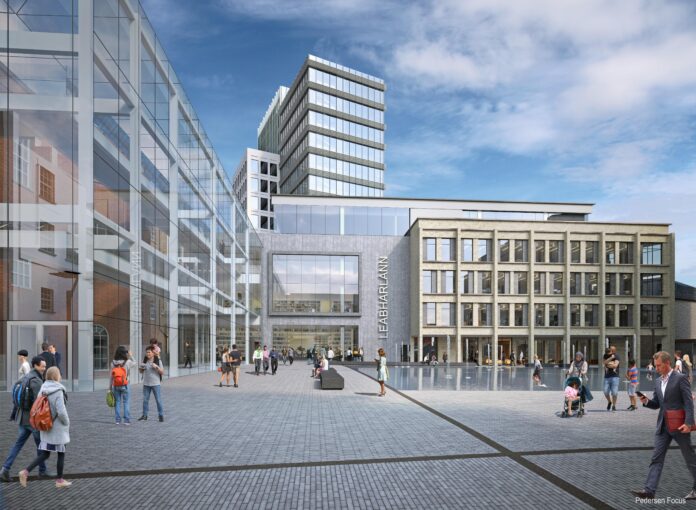
THE Limerick branch of An Taisce is calling for a comprehensive statement from both Limerick Twenty Thirty and Limerick City and County Council in relation to the development of residential housing in the city centre.
In a statement to the Limerick Post, An Taisce Limerick – an active advocate for sustainable, positive development in the city and Mid West region – criticised the lack of development locally.
“Right at this moment in Cork City Centre, there are multiple sites under development to deliver 1,300 housing units comprising of one-bed, two-bed, and three-bed apartments. Many will be completed within 2026 and all 1,300 within 2027.
“In Limerick City, there are currently 36 apartments being built at Speaker’s Corner, but there are no other major developments under construction,” commented Seán McIlfatrick, chair of An Taisce Limerick.

“Each of these housing units in Cork will add to the housing supply – important in the middle of a housing crisis. But every city centre home brings benefits far beyond the home itself. Each home adds to the vibrancy of the city centre, provides a ready footfall for city centre businesses and services, and provides a sense of safety with ‘eyes on the street’.
“This is what we need – more residential units in our city centre, not underused office blocks on premium city centre land.”
An Taisce Limerick pointed to the lack of residential development at Limerick Twenty Thirty’s flagship project at Opera Square – a project that was touted to deliver a 14-storey office building, a new city library, and a vibrant public realm with restaurants, bars, and open entertainment spaces.
An Taisce Limerick believes it’s time to revisit exactly what is being proposed by Limerick Twenty Thirty and its delivery timeline, calling for a clear statement on why an office block is being prioritised over significant residential units and a necessary public library amenity.
According to the local branch of the national organisation, of particular concern is transparency around the funding of the library and the Georgian properties.
“It took a question by Senator Maria Byrne in the Seanad to bring clarity around the library costs and funding to which Junior Minister (Colm) Brophy stated in a response, ‘In August 2018, the cost of the library was initially estimated to be €27million’,” An Tasice Limerick said.
“The current estimate now stands at €50million, which the Council is now seeking funding to cover these costs. Junior Minister Brophy noted that, in the National Development Review published in July 2025, the library project for Limerick was not specifically mentioned, thus raising concerns about the delivery of a much needed library for a large city.”
Planning officer at An Taisce Limerick, Darragh Boyce, noted the continued decades-long dereliction of the Georgian properties of Patrick Street, Rutland Street, and Ellen Street, including the much-loved former Lucky Lamp Public House (Quin’s).
“The delay in retrofitting the Georgian properties into housing and the lack of clarity around funding and timeframes for delivery is calling into question whether Limerick Twenty Thirty DAC and Limerick City and County Council can deliver these vital phases of the Opera site. For context, currently the skyline of Cork City is dominated by 18 tower cranes, the majority of which are delivering housing both private and social of up to 1,300 units along with the redevelopment of the Crawford Art Gallery and a post-primary school extension,” Mr Boyce explained.
Decrease in housing completions
Evidence of this, he added, can be seen in an online video by Drone Hawk Cork entitled ‘Cork is Booming‘.
“This footage brings into focus the shocking disparity between Cork and Limerick, with Limerick currently hosting only a handful of tower cranes with two delivering the University Hospital Limerick extension, one for the Office of Public Works office block at the Opera Site, and just one tower crane in the city centre delivering housing, which is 36 social housing units being delivered by an Approved Housing Body at Speaker’s Corner on Lower Carey’s Road.”
An Taisce Limerick stated that the targets set by Government for the delivery of “own built” social housing by Limerick Council for 2022 and 2024 was 1,580 units, of which a mere 273 were delivered. It also suggested that the Georgian buildings which belong to the Council and are part of the Opera site would have attracted Derelict Sites Notices had they been in private hands.
“These townhouses have been entirely vacant since the summer of 2008 and were the subject of emergency stabilisation works in 2012. Since then no works of any significance have taken place. This swathe of buildings sit on a primary access route to the city centre linking the original historic settlement at King’s Island with the late 18th century Georgian new town. The dilapidated and derelict condition of these 250-year-old buildings projects an appalling image to anybody entering the city centre. Particularly visitors and tourists coming from the medieval area,” An Taisce Limerick said.
An Taisce Limerick now wants the local authority to set an example and get these buildings back into habitable condition, to show by example how restoration can positively change the whole tenor of a street.
The urgent delivery of housing units, particularly in the city centre, the organisation told the Limerick Post, is even more critical given that recent CSO figures have shown a 19 per cent decrease in residential completions in Q1 2026 compared to the previous year, adding: “This marks the third consecutive year where Q1 completions decreased from the previous quarter. Alarmingly, this represents a 31 per cent decrease in completions from Q1 2023.”
An Taisce Limerick said it believes there is significant potential in the repurposing of Sarsfield House into residential units, strongly rejecting any plans for the demolition of the building.
The organisation, which has a prescribed, statutory role as a consultee in the planning process in Ireland, emphasised that repurposing Sarsfield House would not only add to Limerick City’s housing stock, but bring an improved vitality to the Arthur’s Quay Park area.
Referencing a recent report that the local authority had commissioned two assessments of the building, the organisation expressed its concern that any assessment would include a comprehensive calculation of embodied carbon and whole life-cycle emissions that would result from the demolition of Sarsfield House.
‘The city centre is losing out in terms of housing options’
Since September 2025, public bodies must require Whole Life-Cycle Greenhouse Gas Emissions assessments for large-scale public projects. And, since January 1, 2026, projects in receipt of exchequer funding in excess of €10million should produce such an assessment.
“In June 2023 public consultation began on the Arthurs Quay Framework which included Sarsfield House. In October 2024 the public were asked for submissions on what they would like to see happen. A total of 345 submissions were received. It is now three years since the consultation process began and 1.5 years since the public submitted their views. We have yet to see a report with a statistical analysis of what the public’s opinions were. The level of public engagement was significant and Limerick City and County Council owe the public a comprehensive update on the future of the Arthurs Quay Framework, An Taisce Limerick chair Seán McIlfatrick said.
“A retrofit of Sarsfield House into housing units could be earmarked for housing key workers like nurses, hospital staff, teachers, guards, hospitality and retail.”
Mr McIlfatrick said that “there is a housing crisis, a complete lack of supply of homes for people that need them. We need to ensure that we are ambitious, in both thought and action, for our city centre. For a city to survive and thrive, it needs a robust city centre population. Sarsfield House should be high on the list of our public buildings to be converted to
quality, riverside apartments.”
Limerick Chamber backed An Taisce Limerick’s call for greater clarity on the future of the city centre, saying that the questions raised reflect a wider and growing concern amongst the business community around delivery, housing supply, transport certainty, and the availability of scalable land for new homes close to the city.
The Chamber said the discussion must now move beyond individual landmark sites and focus on the wider city centre delivery agenda, including Council-led regeneration projects, public realm improvements, the Land Development Agency’s work at the Gasworks and Colbert Station, the long-delayed City Centre Transport Plan and Arthur’s Quay Framework Plan both to be delivered by Limerick City and County Council, and the current variation process for the Limerick Development Plan.
“An Taisce are correct in highlighting the lack of homes being brought forward in the core city centre, we know from our own analysis that more than half of all homes provided in the city and suburbs over the last decade have been built in Limerick City East, predominantly in the Castletroy area of the city – meaning the city centre is losing out in terms of housing options for workers which feeds into a decline of the city centre,” said Limerick Chamber CEO Donnacha Hurley.
‘Before we can talk about what Limerick could be, we have to be honest about what it currently is’
Social Democrats councillor Elisa O’Donovan also welcomed the calls from An Taisce Limerick for revisions and renewed thinking around landmark buildings in Limerick. However, Cllr O’Donovan maintained that this is not a new issue.
“I have repeatedly called for serious consideration to be given to repurposing buildings such as Sarsfield House for housing and city centre living. However, I have consistently been told that Sarsfield House cannot be used for residential purposes. That cannot be the end of the conversation when we are facing a housing crisis and have significant underused and derelict buildings in the heart of our city,” Cllr O’Donovan said.
Limerick City and County Council, the City West representative believes, needs to be far more proactive when it comes to repurposing derelict and vacant properties across the city centre.
“We need a clear strategy to increase residential occupancy in the city centre, including targeted supports for first-time homebuyers who want to live there, as well as incentives for renters. Bringing more people back into the city centre would support local businesses, improve safety and vibrancy, and help create a stronger and more sustainable urban environment.”
Aontú councillor Sarah Beasley believes Limerick has genuine potential and real ambition, but this must be built on solid foundations.
“Right now we have a library that has nearly doubled in cost to €50million with no funding secured, Georgian buildings that have sat empty since 2008, and a public consultation that closed 18-months ago with still no published outcome,” Cllr Beasley said.
“Before we can talk about what Limerick could be, we have to be honest about what it currently is. Get people living in this city centre, make it somewhere families and workers genuinely want to be, and everything else follows. That is the foundation. Without it, these projects are just expensive promises.”
There was no response from Limerick City and County Council at the time of going to print.
– Local Democracy Reporting Scheme