


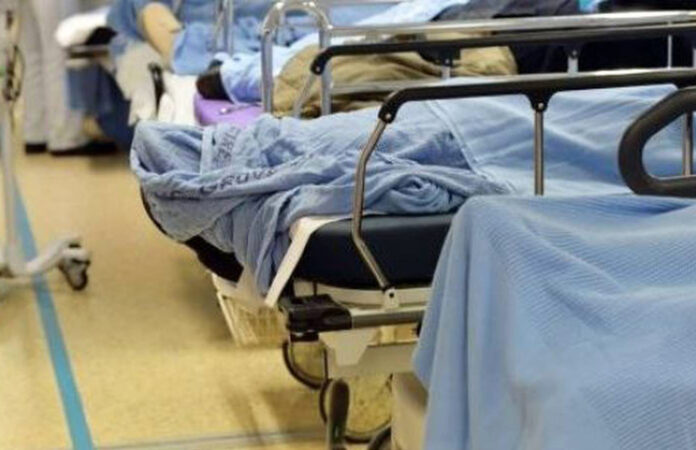
UNIVERSITY Hospital Limerick had 2,018 admitted patients waiting on trolleys for an in-hospital bed throughout the month of May, the highest figure in the country.
That’s according to figures taken from the Irish Nurses and Midwives Organisation (INMO) Trolley Watch, which puts the total figure for the country at 9,811 admitted patients waiting for beds across the month, excluding weekends and bank holidays.
The second highest figures for sick people waiting on trolleys or in overflow wards was at Cork University Hospital, where there were 806 patients admitted and waiting.
“The number of people on trolleys in May has been far too high. We are seeing regular occurrences of daily trolley counts of over 500 people being treated on trolleys, chairs, or other inappropriate bed spaces,” INMO said.

“Nurses and midwives have made it clear that staffing deficits are impacting their ability to provide safe and timely care. Underpinning safe staffing levels with legislation is the only way to make sure hospitals comply with HIQA recommendations on inadequate staffing.”
The nursing union said that “persistent overcrowding carries consequences that extend beyond patient outcomes, it directly threatens the safety and wellbeing of nurses and midwives. Overcrowded hospitals see higher rates of assault against staff, increased burnout, and greater intention to leave the profession.”
In response, a spokesperson for the hospital said that UHL “remains the busiest hospital in the country for emergency department (ED) presentations”.
“So far this year (to May 31st), 41,972 patients have attended ED, approximately nine per cent more than in the same period in 2025.
“ED demand has increased steadily this year. Average daily attendance for May 2026 was 281, and on 10 days of the month attendance exceeded 300, including one of the year’s highest daily attendances—337 patients on May 12.”
The spokesperson said that “to manage patient volumes, the hospital escalation plan also provides for the opening of surge capacity; transferring patients on trolleys to inpatient wards; additional ward rounds by medical teams to expedite discharges or identify patients suitable for transfer to Ennis, Nenagh, and St John’s hospitals; working closely with our colleagues in the community in order to expedite discharges and regular review of scheduled care.”
“It should be noted that the opening of the 96-bed block in UHL last October came shortly after completion of a contract that had provided UHL with access to 50 rehabilitation beds in Nenagh. That contract ended in September 2025, enabling transfer of CNU patients from St Conlon’s to Nenagh CNU. The net gain of the two initiatives for UHL was 46 beds.
“HSE Mid West continues to progress its capital programme to expand acute bed capacity. A 16-bed rapid build unit is under construction at UHL and is due for completion Q4 2026. The second 96-bed block at UHL is due for completion in 2029.”