


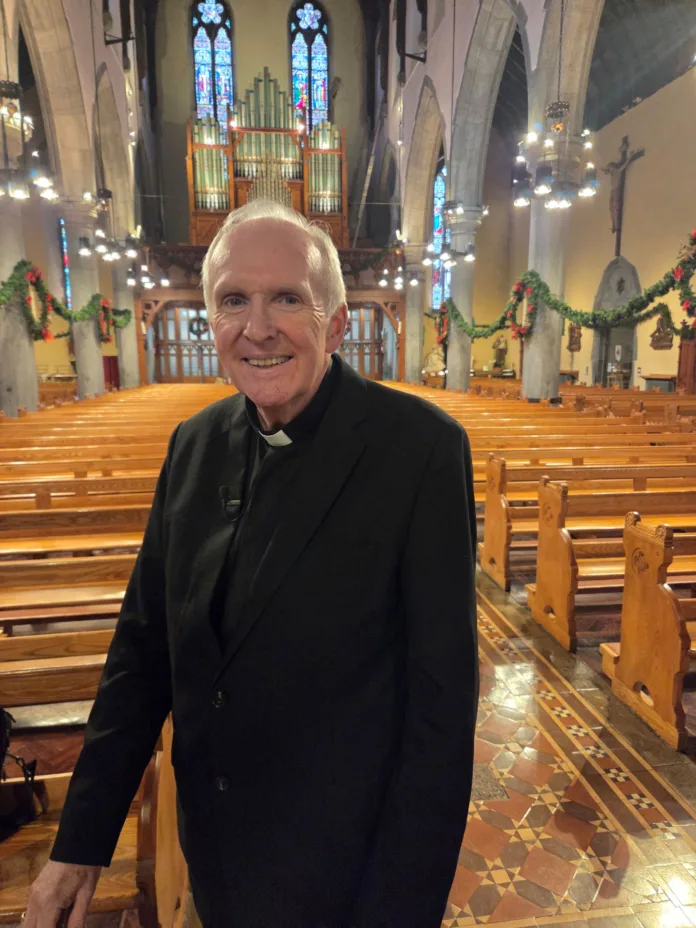
BISHOP of Limerick Brendan Leahy said it is essential that AI be regulated in light of potential “huge risks”.
Bishop Leahy was speaking in the wake of Pope Leo’s encyclical Magnifica Humanitas, and said AI must be for the ”good of humanity and not for the gain of a few”.
Bishop Leahy said AI has the capacity to be as transformative for society but there is a real risk of it also being exploited.
“We are on the cusp of a profound epoch-making shift in humanity. The rapid expansion of digitalisation, artificial intelligence, and robotics will have an increasingly profound impact on social structures, decision-making processes, and the collective consciousness,” he said.

“It has enormous potential for positive advancement, but it has the potential to be destructive.”
He said that “it is essential that AI is regulated quickly and carefully adopted so that it is for the good of wider humanity and not for the gain of a few. If it is not, there’s a real risk it will get away from us in society and do untold damage in the process. As Pope Leo alluded to, there is a real risk it will exaggerate the inequality of the world so, therefore, it must have guiderails.”
Pope Leo was joined at the launch of his encyclical by Christopher Olah, co-founder of leading AI lab Anthropic, whose presence, Bishop Leahy said, was a clearsignal around the ethical concerns with AI.
“Christopher Olah has made it clear that there is a need for oversight from religious leaders, governments, and civil society around the development of AI and that there is a real possibility that AI will impact human labour. We are already seeing that happen in Ireland, no doubt, too, in Limerick,” he said.
“Pope Leo recognised that technological development itself is good as an expression of human creativity, but he warned against the risk of a technocratic paradigm becoming dominant in humanity.”
Bishop Leahy said the Pope “reminded us in the encyclical that ‘artificial intelligences do not experience life, do not possess a body, do not experience joy and pain, and do not know from within what love, work and responsibility mean’.”