


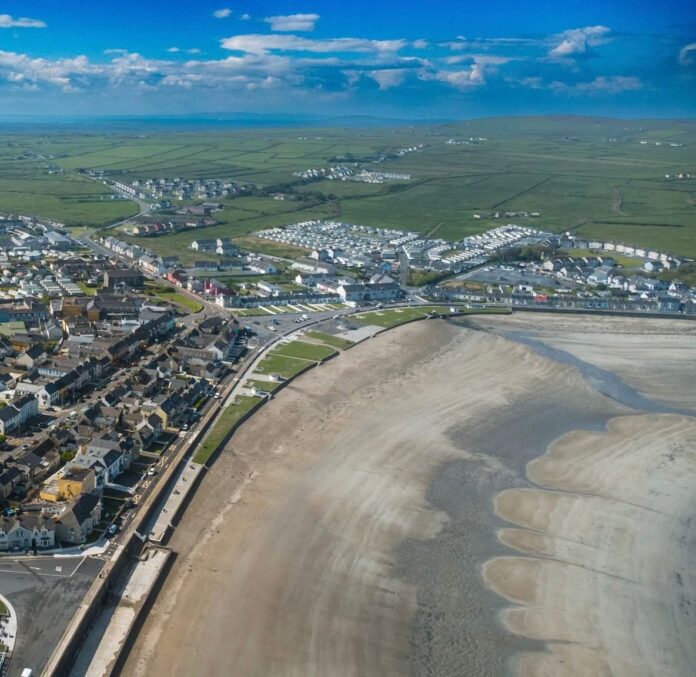
A DRONE video of the scenic cliff walk in Kilkee, beloved of thousands of Limerick visitors, has garnered huge support for a campaign to stop plans for a sewerage treatment plant there.
And following the online posting of the video as part of a campaign to fund a judicial review of the planning decision, a contribution of €20,000 was made by Richard Harris estate and members of his family.
Joanne Dillon, who collaborated with another local objector to the Uisce Éireann project, Ellie Byrne, to produce the drone footage told the Limerick Post: “There has been a huge response since we put that up. I don’t think people were really aware of what’s planned, and to see the site and the beauty of the walk puts in in perspective. It’s like proposing to put a sewerage treatment plant at the Grand Canyon – you just wouldn’t do it.”
A GoFundMe campaign has raised just over €98,000 to fund a judicial review of the Bord Pleanála decision to grant permission for a primary treatment plant.

The legal challenge is due to be heard in the High Court next month.
Uisce Éireann says the facility is needed because untreated wastewater from the seaside town is currently being discharged into the sea.
However, local people are funding a judicial review because they say the proposed facility on Dunlicky Road, a short distance from the cliff walk, is not an appropriate location and will impact the town which is dependent on tourism.
Clare County Council refused planning permission for the treatment plan after receiving almost 90 formal objections.
Following an appeal by Uisce Éireann, that decision was overturned by An Bord Pleanála.
Objectors say that the plant is very necessary, but that this is the wrong plant and in the wrong place, that it is insufficient for the town’s needs and will be an eyesore and a source of bad odours at one of the most popular scenic walks.
“This is a primary treatment plant. The waste will be filtered, not biologically or chemically treated before being pumped out. We need a plant that will do that,” Ms Dillon said.
“The proposed plant is designed to cater for 7,000, when the population of Kilkee goes from 1,000 in winter to 15 and 20,000 in the summer. It’s too small – there’s no room for expansion and building new homes which is something everyone in Kilkee wants to see.”
In an earlier response to objections, Maria O’Dwyer, infrastructure delivery director with Uisce Éireann said there is currently raw sewage coming out of the homes and businesses of the coastal town and flowing into the waste water network, directly into the sea.
“We need to construct our waste water treatment plant that we got planning for in June, so that we can address that.
“We looked at a lot of different options and we deemed this as the most appropriate location for the plant. Our team of engineers, environmental scientists even landscape architects have been working on this and the plant will be sympathetic once it is completed,” she said.
While locals agree that a treatment plant is needed, they say a tertiary plant rather than a primary plant is required to meet the needs of the population which more than doubles to 20,000 during the summer months.
Uisce Éireann says a primary plant is standard for coastal outfall and the proposed facility will cater for summer peaks.
The Judicial Review will take place on June 17 and will assess if An Bord Pleanála – now An Coimisiún Pleanála – erred in its review process, not the merits of the decision.